
A soft ask is a request that a payer bring a short list of a practice's highest-volume codes up to market rate and leave the rest of the contract alone. A full renegotiation reopens the whole fee schedule along with the contract clauses, and it only works when the practice is prepared to walk away. PMI's experience favors trying the soft ask first.
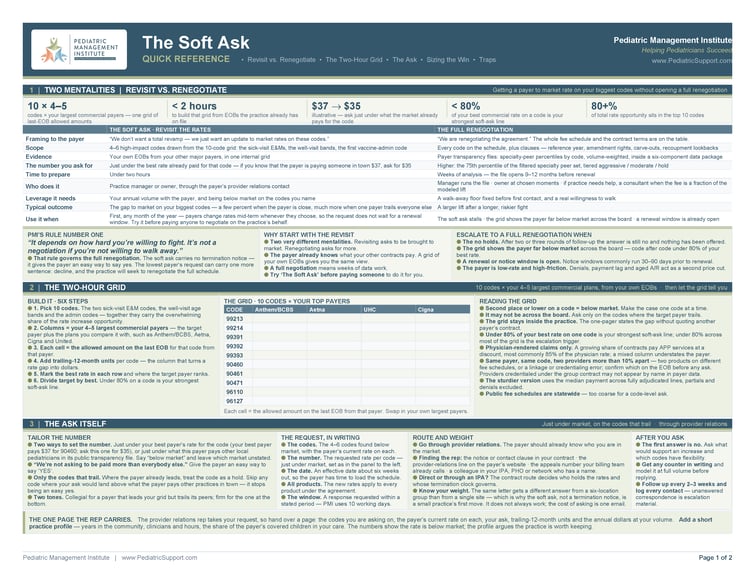
The short answer. The practice builds a grid of its 10 highest-volume codes against its four or five largest commercial payers, filling each cell with the allowed amount from the most recent explanation of benefits (EOB). On any code where the target payer ranks second or lower, the rate is below market. The practice then puts a written request to provider relations covering four to six high-impact codes drawn from that grid, priced just under the going rate so the payer has an easy way to say yes. The grid takes less than two hours to build.
A small cut on the busiest code
When a commercial plan trims its rate for immunization administration, a pediatric practice feels it all year. In a pediatric practice it is often among the highest-volume codes on the schedule, so a small per-unit cut repeats with every vaccine given.
The arithmetic runs the other way, too. Incremental increases on a high-volume code are material. Many owners never ask for one because they assume a better rate requires a full renegotiation. PMI's experience points to an easier first move, the soft ask, built from data already sitting in the practice's own remittances.
Revisiting rates versus renegotiating them
Whether a payer will move depends on how hard the practice is willing to fight, which is why PMI separates revisiting rates from renegotiating them. They are two different mentalities, and the difference shapes every step that follows.
A renegotiation announces that the whole agreement is open. A revisit asks for much less. The practice picks a handful of codes, usually 99213 and 99214, some well visits and a few administration codes, and asks for "an update to market rates on these codes." It tells the payer plainly that it doesn't want "a total revamp." Framed that way, the request never becomes a full renegotiation.
The preparation differs as much as the framing. A soft ask needs one grid and one written request to provider relations. A full renegotiation needs work that starts 9 to 12 months before renewal and a walk-away floor the owners mean. PMI's ordering is to revisit first.
The two-hour grid
The evidence for a soft ask comes from the practice's own EOBs. PMI's first pass is a grid, and a manager can finish it in less than two hours.
- The manager picks about 10 codes that carry the most volume. In pediatrics that usually means 99213 and 99214, the preventive visits by age band (99391 through 99395) and vaccine administration (90460 and 90471), plus a screening code such as 96110 or 96127 where volume supports it.
- The columns are the practice's four or five largest commercial payers.
- Each cell holds the allowed amount from the most recent EOB for that code from that payer.
- A last column records each code's units over the trailing 12 months, for pricing the gaps later.
Each row gets read on its own. The payer won't be below market on every code, and it doesn't have to be. On any row where it sits in second place or lower, the rate is below market. Those rows are the candidates. The ask itself runs to four to six high-impact codes drawn from them, usually 99213 and 99214, the well-visit bands and the first vaccine administration code. The practice skips any code where the ask would land above what the payer pays other practices in town, because it stops being an easy yes, and it leaves low-frequency codes for the full renegotiation. Rows where the payer already pays best stay off the list, and the practice watches them, because payers tend to fund increases by trimming codes a practice forgets to protect.
PMI adds one more flag. A rate below roughly 80% of the practice's best commercial rate for the same code is the strongest line in the soft ask. A grid full of them is the signal to escalate to a full renegotiation.
A few things in the remittance data mislead. The volume column counts units, not claim lines, since a multi-unit line counted once overstates the effective multiplier. Two different rates for one code under one payer are often two products on different fee schedules rather than an error, and the EOB says which. Providers credentialed under the group contract may not appear by name in payer data at all, which is worth knowing before anyone reads a per-provider report as a rate problem.
Every number on the grid is the practice's own, drawn from its contracted rates across its own payers. The grid stays inside the practice. The one page handed to the payer states the gap without quoting another payer's contract. Sharing or coordinating rates with other practices invites antitrust exposure, and payer contracting is where that law gets enforced. Reading a payer's published rates is price-checking, the way one restaurant knows what another charges. Agreeing on rates with another practice is the line.
Asking for just under market
The number should be easy to grant, and PMI sets it in one of two ways. The first is just under the practice's own best rate for that code. PMI's illustration: if the practice's best payer pays $37 for 90460, it asks the target payer for $35. The second is just under what the same payer pays other local pediatricians in its public transparency file. Either way the request says the current rate is below market and leaves which market unstated. The practice isn't asking to be paid more than everybody else, and pricing the request $2 under market gives the payer an easy way to say yes. A full renegotiation is where the practice asks for more.
Two checks come first. One is whether the contract is direct or held through an independent practice association (IPA), since the contracting route decides who holds the rates. The other is the practice's weight with this payer. The request goes through provider relations, and the plan should know the practice's position in the market. A statewide plan may not know it offhand, but its staff can quickly see the annual dollars, and a plan that consistently sends a practice seven figures a year should pay attention. Weight also sets expectations, because the same letter gets a different answer from a six-location group than from a single site, which is why the soft ask, rather than a termination notice, is a small practice's first move. It does not always work.
Finding the right name takes a few minutes. It sits in the notice or contact clause of the contract, on the provider-relations line on the payer's website, behind the appeals number the billing team already calls, or with a colleague in the practice's IPA, physician-hospital organization (PHO) or network who has a name to pass along.
The request itself goes in writing. It lists the codes found below market with the payer's current rate on each, states the requested rate per code, sets an effective date about six weeks out so the payer has time to load the schedule, says that the new rates apply to all products under the agreement, and asks for a response inside a stated window, which at PMI is 10 working days.
The payer already has a good idea what the practice's other contracts pay, so the request doesn't need to prove a market exists. Tone still matters. A calm request for parity on named codes goes over better than anything that sounds like an accusation.
The soft ask carries no termination notice. The request to the lowest-paying payer can carry one more sentence, that if the request is declined the practice will seek to renegotiate the full fee schedule. Two tones cover the range: collegial for a payer that leads the practice's grid but trails its peers, firm for the one at the bottom.
PMI's advice is to try this before paying someone to do it on the practice's behalf. The practice might be pleasantly surprised. The request can go out in any month of the year, because payers change rates mid-term whenever they choose, so it does not wait for a renewal window. Once a year, in the same month, the practice rebuilds the grid and sends the request to its lowest-paying contract. PMI does that work in August.
What a few dollars on a high-volume code is worth
What a soft ask returns is the gap to market on the biggest codes, a few percent when the payer is already close and much more when one payer trails everyone else. Per unit those gains look small, which is why they get underrated. PMI prices every gap with one formula: (target rate − current rate) × units over the trailing 12 months = annual dollars.
In PMI's worked example, a 99392 paid at $128 with an ask of $140, billed 1,850 times a year, is a $12 gap worth $22,200 a year from one code. The figures are illustrative, but the multiplication works the same for a soft ask. It also explains why a small cut on vaccine administration hurts.
The top 10 codes typically carry 80% or more of a practice's total rate opportunity, so the grid covers most of what is at stake. PMI's sequencing is to ask the lowest payer and the next one up in the same week, because a yes from the better payer funds the hard choice on the worst one. And where the practice spends money to bring patients in, PMI's view is that it starts with the better-paying payer's members, because the spread between payers on the same visit can run 30%.
When the soft ask isn't enough
Sometimes the no holds after two or three rounds of follow-up, with nothing offered. Some payers turn out to be far below market on most of the grid, and sometimes a renewal window is already open. Then PMI moves to a full renegotiation, which means working through the data in detail. That takes time.
The case rests on six components:
- The contract file, meaning the current agreement, every amendment, the operative fee schedule and the renewal and notice dates.
- The practice's numbers with this payer, from trailing-12-month volume and revenue to denial rate and payment lag.
- The clinical and quality story, such as immunization rates and after-hours access.
- Panel demographics by age, zip code, language and employer.
- The market benchmark, built code by code from rates insurers publish under federal price-transparency rules.
- A one-page narrative a payer's medical director can read in about three minutes.
Each code target anchors to the 75th percentile of a filtered pediatric peer set, defensible because a quarter of comparable groups already receive it. Codes already at or above that level are named and defended. Before first contact, the owners fix the opening ask, the expected settlement range and the walk-away floor. The work starts 9 to 12 months before renewal, because notice windows commonly run 90 to 180 days.
The walk-away analysis gets built before the first meeting, never during it. It starts from the payer's contribution margin, its payments minus the costs its volume adds, and models how much volume would come back if the practice left. It usually argues for patience. It still has to exist, because PMI's first rule holds: it's not a negotiation if the practice isn't willing to walk away. No owner can be willing without knowing the price. A contracting consultant earns the fee at this stage when that fee is a fraction of the modeled lift.
After the payer answers
The first answer to a rate request is usually no. PMI's guidance is to stay in the conversation and ask what would support an increase. Every contact goes in a log. If the representative stalls, the request moves up to the network manager and then to the payer's medical director.
Mail marked "amendment" is a contract event too. Under a unilateral-amendment clause, a practice that fails to object inside the window has accepted the change.
Traps in the counter-offer
- Judging one code family. Every counter gets modeled across all code families at actual volumes. An evaluation and management (E/M) increase paired with a vaccine-administration trim can net negative.
- A frozen reference year. A rate pegged to a fixed year's Medicare schedule erodes as Medicare updates. In PMI's worked example, a stated 140% can be worth about 133% of current Medicare after four years. The fix is "current year" language.
- Carve-outs. A headline percentage can cover E/M alone, with vaccine administration and screenings paid on separate terms.
- Automatic renewal. An evergreen clause rolls the fee schedule over untouched, year after year. A fixed term that expires forces the payer back to the table before it does, so the practice does not agree to automatic renewals.
- Verbal offers. A number mentioned on a call isn't an agreement until it's in writing.
- Rates never loaded. New rates go into the expected-pay tables, and the first 90 days of remittances get audited line by line.
Frequently asked questions
How do you ask an insurance company to raise reimbursement rates?
PMI's recommended first step is a soft ask, a request that the payer update a short list of high-volume codes to market rate. The manager builds a grid of the top 10 codes against the four or five largest commercial payers, using the allowed amount on each payer's latest EOB. Four to six high-impact codes where the target payer ranks second or lower go to provider relations in writing, priced just under the going rate.
What is the difference between a rate update and a full contract renegotiation?
A rate update covers a handful of high-volume codes and rests on the practice's own EOBs, which take under two hours to organize. A full renegotiation reopens the whole fee schedule and the contract clauses. It needs a six-part data package, peer-benchmarked targets, a walk-away floor and a start 9 to 12 months before renewal. PMI recommends trying the update first.
Is it legal to compare insurance rates with other medical practices?
A practice can compare its own contracted rates across its own payers, which is exactly what the soft-ask grid does. The trouble starts when practices share rates with competitors or agree on what any of them will accept, because payer contracting is where antitrust law gets enforced. Legitimate joint structures, such as IPAs that meet integration standards, follow separate rules, and the practice's attorney can say where the line sits.
Know where every rate stands before the call
PMI's payer contract analysis lines up a practice's rates code by code across its payers and prices each gap in annual dollars at the practice's own volume. It shows whether a soft ask will do or the numbers call for a full renegotiation. To start with a practice's own contracts, schedule a discovery call.
This article is general guidance for pediatric practice owners. Individual payer contracts and policies vary and govern. Practices compare their own contracted rates across their own payers and never coordinate rates with other practices.