
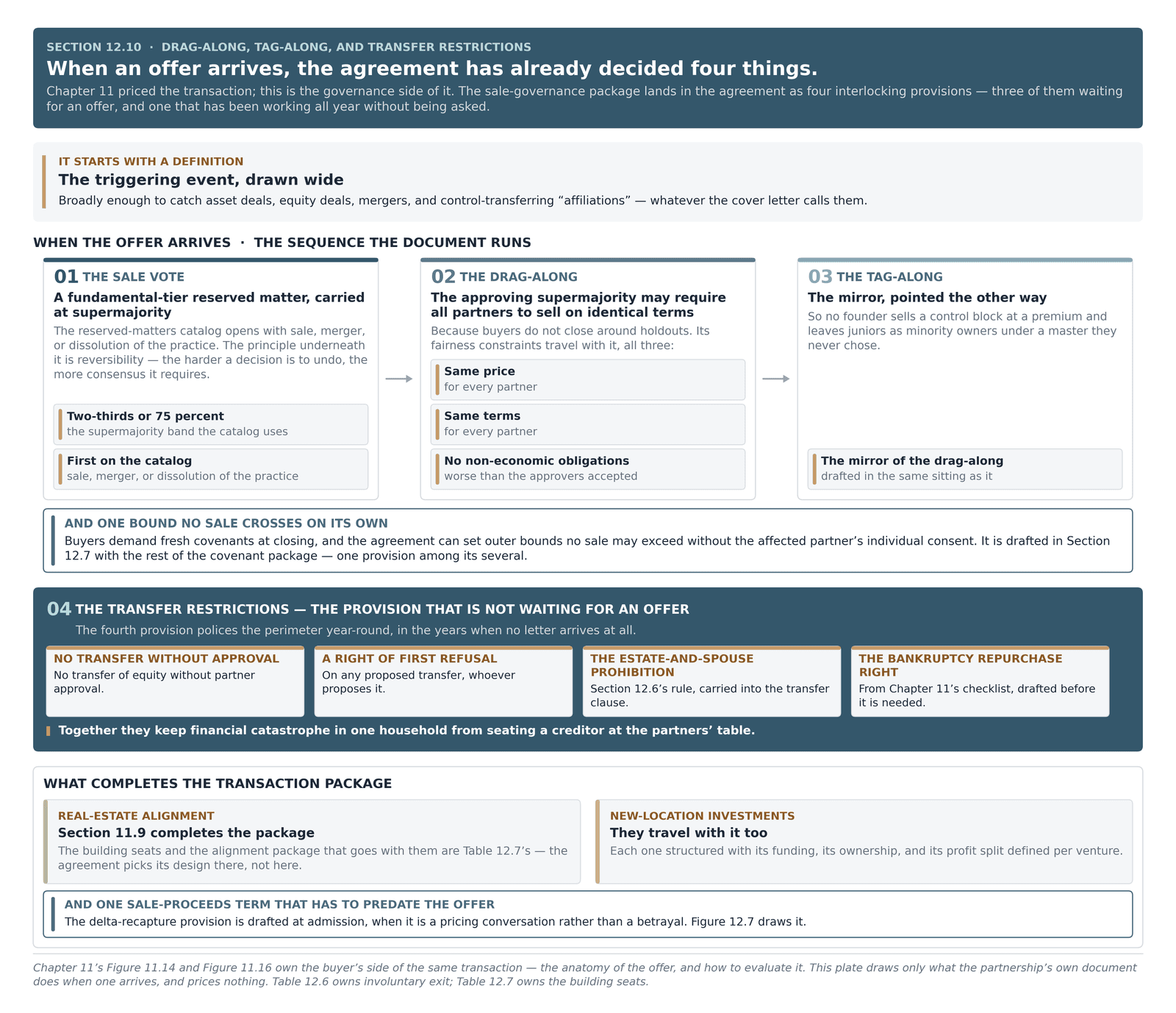
Transfer restrictions govern every way an ownership interest can move, including sale, gift, pledge, trust transfer, divorce decree, judgment, and probate. A violating transfer is void and triggers repurchase at formula value, right-of-first-refusal mechanics run in stated days rather than reasonableness, and legitimate estate planning gets an explicit lane so the restriction does not overreach.
Whether a partner may sell an interest in the practice to an outside investor without asking anyone is a question most agreements answer by accident. The answer that follows from silence is usually yes. A partner can sign a term sheet on a Saturday, pledge an interest as collateral for a personal loan, gift a slice to an adult child, or move the whole holding into a family trust—and the first the other partners hear of it is when a stranger’s counsel asks for the practice’s financial statements, on the strength of an ownership interest nobody voted on.
Transfer restrictions are the gatekeeping provision of a medical practice partnership. They are unglamorous, they run year-round rather than firing on an event, and they are the reason the people in the partners’ room are the people the partners chose.
Begin with the definition, because a restriction is only as good as the conduct it reaches. Define transfer to include every way an interest can move: sale, assignment, gift, exchange, pledge or hypothecation as security for a debt, contribution to another entity, transfer into or out of a trust, and any change in control of an entity that holds an interest. Include involuntary transfers by operation of law—a divorce decree, a judgment creditor’s execution, a bankruptcy estate, or a probate distribution—because those are the transfers that happen without anyone at the practice being asked. A restriction drafted around voluntary sales alone will meet its first real test at a moment nobody planned for and will not answer it.
Then set the consent rule. No transfer of equity without partner approval, at unanimity or a stated supermajority, is the rule the governance dataset carries and the rule most functioning practices adopt. Pair it with the remedy, because a prohibition without a consequence is advice: an attempted transfer in violation of the provision is void, confers no rights on the transferee, and triggers the practice’s option to repurchase the interest at formula value. And require that any approved transferee sign a joinder accepting the agreement in full, covenants and capital obligations included. An interest that arrives in new hands free of the restrictions that governed it in the old ones has defeated the provision on the way through.
A right of first refusal sits underneath the consent rule and does different work. Where consent is a veto, the right of first refusal is a purchase option, and it is what allows the partners to say no to the buyer without saying no to the seller’s money. Draft it with the mechanics spelled out: written notice of any bona fide third-party offer, with the offer’s material terms disclosed; a defined election window measured in days rather than in reasonableness; a stated order of priority, typically the practice first and then the remaining partners pro rata, with any unsubscribed portion offered again to those willing to take it; a stated price, either matching the third-party offer or set at the agreement’s formula value; and a closing deadline with payment terms that mirror the ordinary buyout note. Whichever price convention the partners choose, choose it in writing. A right of first refusal that reads “on terms to be agreed” is a delay, not a right.
The estate-and-spouse prohibition is the provision that surprises people, and it deserves the sentence that explains it. On a partner’s death, the agreement should mandate a buyout of the estate rather than allow the estate to inherit the seat. The distinction is between money and governance: the family is entitled to the value of the interest, and the practice is entitled not to acquire a non-physician co-owner who has never seen a patient and never agreed to anything. The same logic runs through divorce. In community-property states, equity built during a marriage is presumptively marital property, so a partner’s divorce can put ownership in play without anyone having breached anything. Spousal signatures collected at admission—acknowledging the buy-sell terms and waiving ownership claims beyond the economic value—are the front-end protection, and the transfer prohibition is the backstop. The acknowledgment is unobtainable during a divorce, which is precisely why it is obtained at admission. The liquidity side of the same event is just as real. At Acme Pediatrics, a four-physician practice, Dr. Brown was in the middle of a divorce and could not fund her $100,000 tranche of a $1.2 million capital call—and because the agreement already carried a partner-loan mechanism, no meeting was required. Articles 34 and 35 carry the death and divorce triggers in full.
Now the exception that keeps the provision from becoming its own problem, because a restriction drafted too broadly forces physicians into personally holding shares that their tax and estate planning says they should not hold. Permitted transfers are the narrow carve-out, and narrow is the operative word. The usual formulation allows a transfer to an entity or trust wholly owned or controlled by the physician, and wholly for her benefit, provided that she remains the sole beneficial owner, remains personally bound by every covenant and guarantee, remains the person who votes the interest and provides the clinical services, and provided the interest returns to individual ownership or triggers the buyout if any of those conditions fails. Whether a given holding structure is permissible at all is not a drafting preference. State professional-entity and corporate practice of medicine statutes govern who may own an interest in an entity that practices medicine, payer credentialing and enrollment may be affected, and the tax consequences run in several directions at once. That combination is a question for healthcare counsel and the practice’s accountant, working together, before the structure exists rather than after.
Two more provisions complete the perimeter. The bankruptcy repurchase right lets the practice buy back an interest that a partner’s personal insolvency has put in play, which keeps a creditor out of the partners’ room. And the pledge prohibition—no practice equity offered as collateral for personal borrowing—closes the seam that creates that risk in the first place.
Transfer restrictions also have to be reconciled with the money that funds the buyouts, and this is the check most agreements never run. Life insurance sized to the buyout obligation only works if the policy’s ownership and beneficiary designations point where the agreement points. In an entity redemption the practice owns the policies and buys the interest; in a cross-purchase the partners own policies on one another. The two structures distribute the proceeds differently, they are taxed differently, and an agreement that mandates one while the insurance file executes the other will produce a funded promise nobody can perform. Review the transfer provisions, the buy-sell triggers, and the insurance file in the same meeting—the annual audit of article 50 is where that belongs—and have counsel and the insurance advisor confirm they describe the same transaction.
One boundary is worth naming. Transfer restrictions govern the year-round movement of individual interests. They are not the sale provisions. When the whole practice is on the table, the drag-along, tag-along, and sale-vote provisions of article 24 do that work, and they operate on different logic.
Red flags. No transfer restrictions at all, so a partner sells to an outside investor and the first notice is a phone call. No right of first refusal, leaving the partners with a veto and no way to buy. An estate that automatically inherits ownership, seating a non-physician who never agreed to the agreement. Transfers to a physician-controlled holding entity prohibited outright, forcing a partner into a structure her accountant advised against. And a restriction drafted so broadly that ordinary estate planning requires an amendment, which is how a good provision gets waived one exception at a time.
If a practice would not choose its partners’ business partners, the agreement had better say so.
Red flags in transfer restrictions
- No transfer restrictions at all, so a partner sells to an outside investor and the first notice is a phone call.
- No right of first refusal, leaving the partners with a veto and no way to buy.
- An estate that automatically inherits ownership, seating a non-physician who never agreed to the agreement.
- Transfers to a physician-controlled holding entity prohibited outright, forcing a partner into a structure her accountant advised against.
- A restriction so broad that ordinary estate planning requires an amendment, waiving the provision one exception at a time.
Frequently asked questions
Can a partner sell a practice interest to an outside investor?
Not where the agreement prohibits transfer of equity without partner approval, at unanimity or a stated supermajority. Silence usually answers yes. The prohibition needs a remedy to have force: an attempted transfer in violation is void, confers no rights on the transferee, and triggers the practice's option to repurchase the interest at formula value.
What does a right of first refusal do?
It allows the partners to say no to the buyer without saying no to the seller's money. The mechanics have to be spelled out: written notice of any bona fide third-party offer with its material terms, a defined election window measured in days, a stated order of priority, a stated price, and a closing deadline.
Can an estate or a spouse end up owning part of a practice?
The agreement should mandate a buyout of the estate rather than allow it to inherit the seat, so the family receives the value of the interest while the practice avoids a non-physician co-owner. Spousal signatures collected at admission, acknowledging the buy-sell terms and waiving ownership claims beyond economic value, do the same work for divorce.
Put the agreement to the test
The Partnership Agreement Analyzer scores an existing agreement against the framework this series is built on — or schedule a discovery call to work through it with PMI. The full framework, with the arithmetic, lives in the textbook Pediatric Practice Management: The Fundamentals.