
Many partnership agreements pay a departing partner their initial investment or capital account balance plus their own accounts receivable collected for a stated window after the last clinical day. Visit revenue in that window is straightforward, because the partner did the work. Vaccine drug and lab revenue is different, because the practice bought the product. Whether it belongs in the payout turns on a single question about the compensation formula, and the answer was settled years before anyone gave notice.
The short answer. If the compensation formula charged the departing partner the cost of vaccine drugs and lab supplies before computing earnings, the run-out pays out the revenue collected on those items along with everything else. If the formula never touched those costs, vaccine drug and lab revenue stays with the practice, because the practice bought the product and was never repaid through the formula. Vaccine administration stays in the payout either way, since giving the shot is the physician's own work. The run-out pays collections on the partner's own claims, by rendering provider, after the offsets the agreement names, and the rule is written down once so that it governs every exit trigger.
What the run-out pays for
A common structure pays a retiring or resigning partner two things: their initial investment or capital account balance, and the partner's own accounts receivable collected for a stated window after the last clinical day. Three months is a frequent window, and agreements vary. PMI's view of the structure is favorable. It keeps a practice sustaining, and it ties the payout to money that actually arrives rather than to a valuation argument.
Most of what comes in during that window is uncomplicated. Office visits, preventive visits, vaccine administration and procedures are the departing partner's own work, billed under that partner's name. The revenue was earned by the physician who is leaving and the collection is simply late.
Vaccine drugs and in-office lab are a different kind of line. The practice bought the HPV dose before anyone administered it, and bought the strep test cartridge too. Payment on those claims reimburses a purchase the practice made, and most of the dollar is cost rather than margin. Whether that revenue belongs in a departing partner's payout turns on one thing, which is whether the compensation formula ever charged that partner the cost of the product.
Two trajectories, one rule
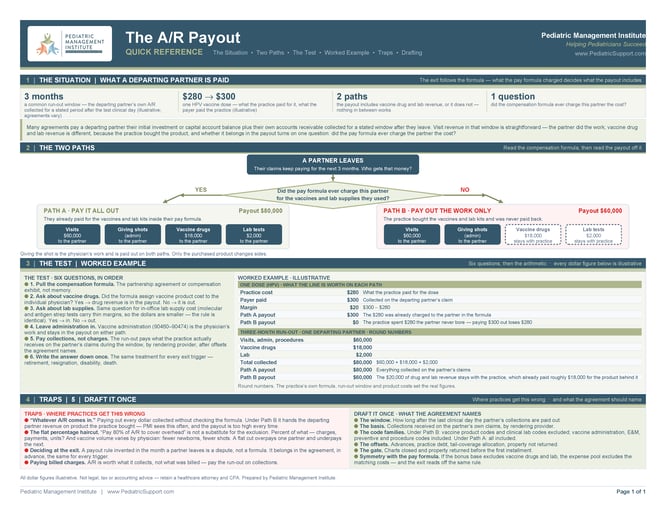
There are two paths, and nothing between them works.
Path A is a practice whose compensation formula charged each physician their vaccine drug and lab supply cost before computing earnings. That can run through an allocated expense pool, a netted vaccine margin, or a per-provider expense charge against production. On Path A the payout includes vaccine drug and lab revenue collected on the partner's claims, along with visit, administration and procedure revenue. The partner already carried the cost inside the formula, so the collection is the payment that partner was waiting for.
Path B is a practice whose formula never touched those costs. Equal shares, pay by days worked, a flat salary, and "what is left, divided" all land here. On Path B the payout covers visit, administration and procedure revenue only, and vaccine drug and lab revenue stays with the practice. The practice bought the product and was never repaid through the formula, so paying the revenue out pays the same dollars twice.
Vaccine administration stays in the payout on both paths. Codes 90460 through 90474 pay for the physician's work rather than for a purchased product, so no allocation question attaches to them.
The formula gets evaluated first, and the payout gets read off it. A practice that starts from the payout and reasons backward ends up arguing about fairness with no rule to point at.
The test, in six steps
- Pull the compensation formula. The partnership agreement or the compensation exhibit, not anyone's memory of the last exit.
- Ask about vaccine drugs. Whether the formula assigned vaccine product cost to the individual physician. If it did, drug revenue belongs in the payout. If it did not, drug revenue stays out.
- Ask the same about lab supplies. In-office lab supply cost gets identical treatment. Molecular and antigen strep testing carries thin margins, so the dollars are smaller, and the rule does not change.
- Leave administration in. Vaccine administration is the physician's own work and stays in the payout on either path.
- Pay collections, not charges. The run-out pays what the practice actually receives on the partner's claims during the window, by rendering provider, after the offsets the agreement names. A/R is worth its collectible value, which decays as it ages, and never its billed value.
- Write the answer down once. The same treatment applies to every exit trigger, meaning retirement, resignation, disability and death.
One dose, then one run-out
The figures below are illustrative. A practice's own formula, run-out window and product costs set the real ones.
Start with a single HPV dose. The practice paid $280 for the vial and the payer paid the practice $300, leaving $20 of margin. On Path A the payout on that line is $300, because the $280 was already charged to the departing partner inside the compensation formula. On Path B the payout on that line is $0. The practice spent $280 the partner never bore, so paying out the $300 hands over money the practice needs to cover its own purchase.
Scaled to a three-month run-out for one departing partner, in round numbers: visits, administration and procedures collect $60,000, vaccine drugs collect $18,000, and in-office lab collects $2,000. Total collections on that partner's claims come to $80,000.
On Path A the payout is $80,000. On Path B it is $60,000. The $20,000 of drug and lab revenue stays with the practice, which already spent roughly $18,000 buying the product behind it. The gap between the two paths is the cost of goods the practice paid for, rather than a haircut for overhead.
Where practices get this wrong
- "Whatever A/R comes in." Paying out every dollar collected in the window without reading the formula first. On Path B that hands the departing partner revenue on product the practice bought. PMI has run into it roughly a dozen times in the past two years, and the payout was too high every time.
- The flat percentage haircut. "Pay 80% of A/R to cover overhead" is not a substitute for the exclusion. A percentage of what, since total vaccine charges, total vaccine payments and total vaccine units each give a different answer. Vaccine volume varies by physician as well, because a partner with fewer newborns on the panel gives fewer shots. One flat rate overpays one departing partner and underpays the next.
- Deciding at the exit. A payout rule invented in the month a partner leaves is a dispute rather than a formula. It belongs in the agreement, in advance, written the same way for every trigger.
- Paying billed charges. A/R is worth what it collects, not what was billed, and the gross collection rate falls with every aging bucket. The run-out pays on collections.
What the agreement names
PMI's drafting standard is that a departing partner's A/R rights are defined once and apply to every trigger, so nobody negotiates the rule while a partner is walking out the door. Six items carry it.
- The window. How long after the last clinical day the partner's collections are paid out, and on what installment schedule.
- The basis. Collections received on the partner's own claims, identified by rendering provider.
- The code families. Under Path B, vaccine product codes and clinical laboratory codes are excluded, while vaccine administration, evaluation and management, preventive and procedure codes are included. Under Path A, all of them are included.
- The offsets. Advances, practice debt, the tail-coverage allocation, and property not returned.
- The gate. Charts closed and property returned before the first installment goes out.
- Symmetry with the pay formula. If the bonus base excludes vaccine drugs and clinical lab, the shared-expense pool excludes the matching costs, and the exit provision reads off that same rule.
The pay formula decides the exit
The decision that keeps vaccine drugs and clinical lab out of a production bonus base is the decision that sets the exit. PMI's compliance drafting excludes vaccine drugs, clinical laboratory and all designated health services from the collections a bonus is computed on, and excludes the corresponding costs from the shared-expense pool, because revenue and its cost move together. A practice that has held that line through the associate years has already answered the A/R question, and the answer is Path B.
Where the allocation runs the other way, with each physician charged their own vaccine and lab cost, the answer is Path A and the payout is larger. Neither answer is wrong on its own. The trouble comes from a practice that charges nobody for the product and then pays the revenue out anyway.
How the partners are paid and what the exit looks like are strongly correlated, and vaccine drugs are one example among several. The allocation choice decides the margin during the working years and the size of the check at the end. Practices that read the compensation formula and the buyout provision in the same sitting catch the mismatch while it still costs nothing to fix.
Frequently asked questions
Does a departing partner's A/R payout include vaccine revenue?
It depends on the compensation formula. If the formula charged that partner the cost of vaccine drugs before computing earnings, the run-out pays out the vaccine drug revenue collected on their claims. If the formula never allocated that cost, vaccine drug revenue stays with the practice, because the practice bought the product and was never repaid through the formula. Vaccine administration stays in the payout under either answer, since administration is the physician's own work. In-office lab supply revenue follows the same rule as vaccine drugs.
Can you use a flat percentage of A/R instead of excluding vaccine revenue?
PMI advises against it. A haircut such as "pay 80% of A/R" leaves open what the percentage applies to, and total vaccine charges, total vaccine payments and total vaccine units each produce a different number. Vaccine volume also varies by physician, since a partner with fewer newborns on the panel gives fewer shots, so one rate overpays one departing partner and underpays the next. Naming the excluded code families is more precise and takes no more drafting.
How long should a partner A/R run-out last?
Three months after the last clinical day is a common window, and agreements vary. What matters more than the length is that the agreement fixes the window in advance, pays on collections received rather than charges billed, identifies the claims by rendering provider, and applies the same rule to every exit trigger, meaning retirement, resignation, disability and death. Transition obligations such as closed charts and returned property usually gate the first installment.
Settle the payout rule before anyone gives notice
PMI helps pediatric practice owners align the pay formula, the buy-in and the exit so the same rule governs all three. Start with the PMI partnership resource hub, or schedule a discovery call to test a practice's own agreement against its compensation formula.
This article is general guidance for pediatric practice owners and is not legal, tax or valuation advice. Engage counsel and a CPA before changing any employment or partnership agreement.