
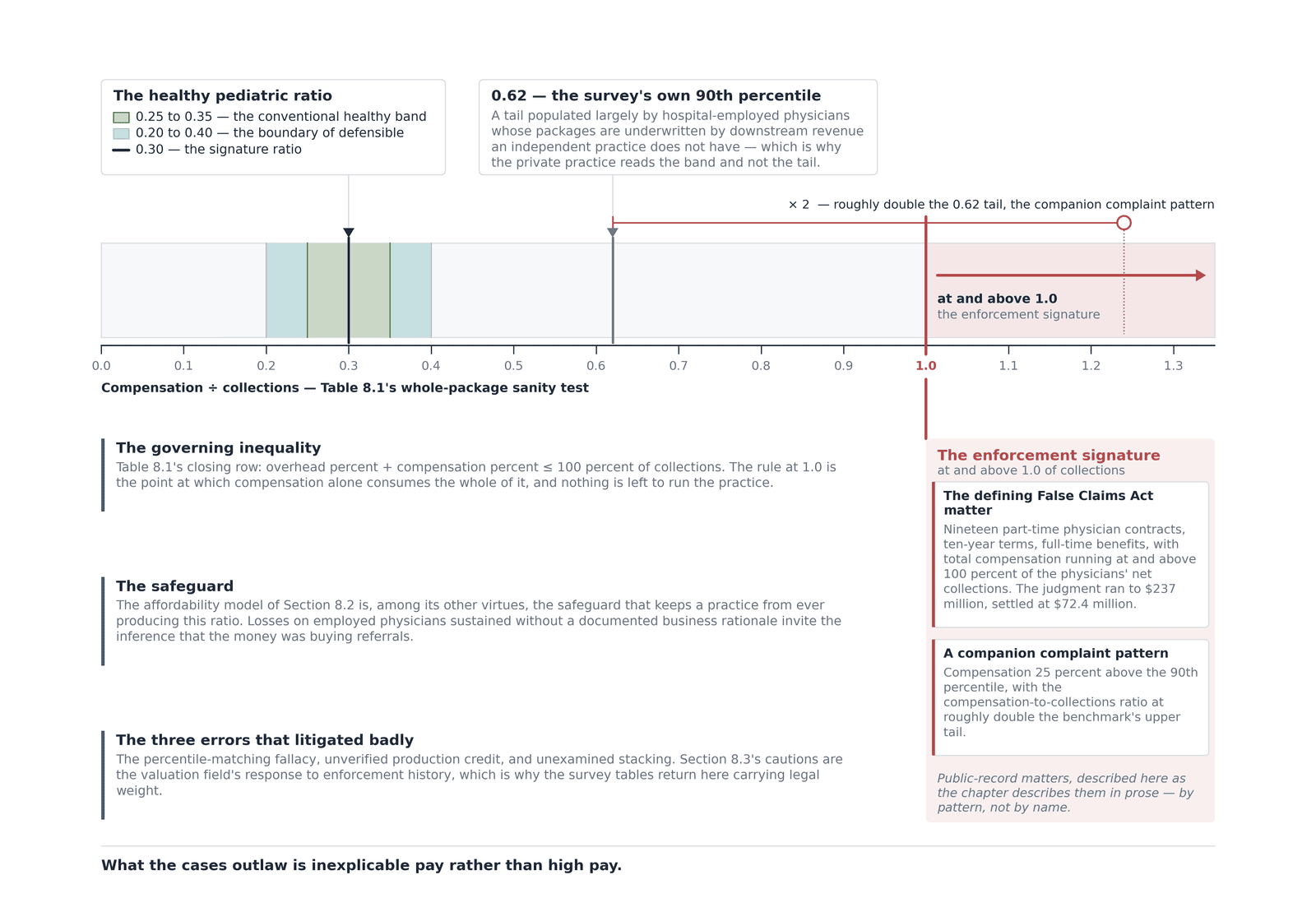
Enforcement cases cluster where physician compensation reaches or exceeds 1.0 times collections, against a healthy pediatric ratio near 0.30. The article separates fair market value from commercial reasonableness as two independent gates, shows a four-physician practice stripping laboratory and vaccine administration out of a bonus definition, and names the five events an agreement should treat as automatic triggers rather than debates.
Federal compensation law reads, to most independent pediatricians, like a hospital problem. That assumption fails on three facts, and it fails in a way that reaches every partner rather than the one who made the mistake.
The first fact is that Medicaid is a federal healthcare program, and it is 30 to 60 percent of most pediatric panels. The second is that in-office laboratories and certain other services a pediatric practice bills are designated health services within the Stark law’s reach. The third is the whistleblower architecture of the False Claims Act, which makes the practice’s own disgruntled former biller a potential enforcement agency. A pediatric group’s own laboratory is nonetheless lawful, and the reason has a name: the in-office ancillary services exception permits a group practice to bill for designated health services it performs itself, provided the group meets the exception’s definitional tests. Those tests are exactly what the group-practice profit-sharing rules exist to satisfy. What the guardrails ask of a partner is working literacy—not an attorney’s command of the statutes, but enough to recognize when a design needs counsel.
The two statutes, in one paragraph. The Stark law is a strict-liability civil statute: a physician may not refer designated health services payable by Medicare, and contestedly Medicaid, to an entity with which she has a financial relationship unless an exception applies. Intent is irrelevant. The arrangement either fits an exception or it does not. The Anti-Kickback Statute is a criminal intent statute: knowingly and willfully offering, paying, soliciting, or receiving anything of value to induce federal-program referrals, with safe harbors that protect structures meeting their conditions. Employment is the great sheltering exception under both, on the same three conditions—identifiable services, compensation at fair market value, and compensation not determined in a manner that varies with the volume or value of the physician’s referrals. Productivity bonuses on personally performed services are expressly permitted. The compensation may track what a physician does. It may not track what she refers.
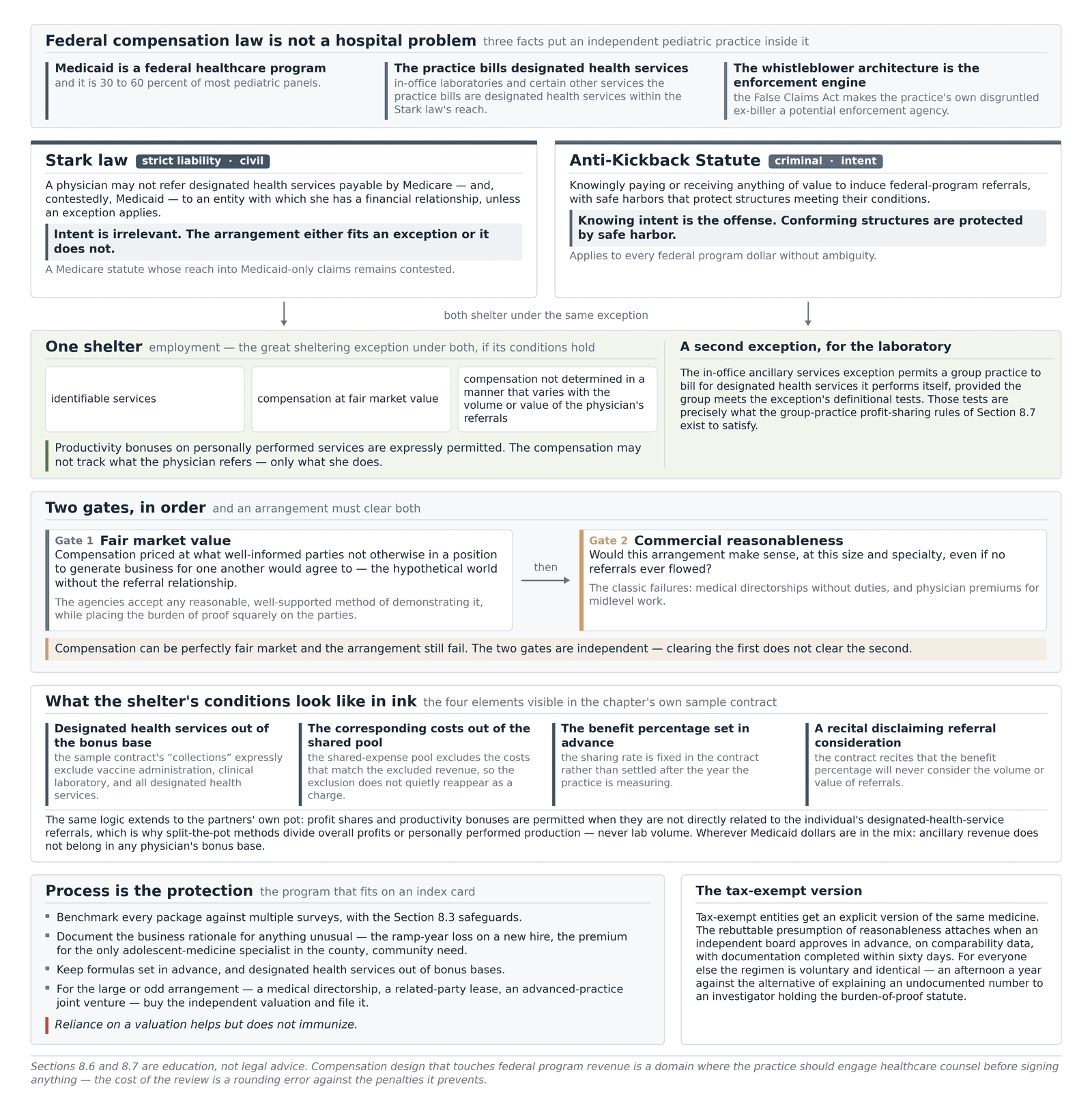
That single distinction dictates how the partnership agreement’s compensation article must be drafted. Designated health services stay out of every bonus base. Profit shares divide overall profits or personally performed production, never laboratory volume. The document recites that no distribution or bonus percentage considers the volume or value of referrals. And any amendment to a compensation formula routes through healthcare counsel before adoption rather than after. The pattern is visible in well-built pediatric contracts. At Acme Pediatrics, a four-physician practice whose panel runs 44 percent Medicaid, the definition of “collections” in Dr. Taylor’s bonus formula strips clinical laboratory and every other designated health service before a dollar is computed, and vaccine administration with them, so the number the contract pays her on is deliberately smaller than the number the practice’s analytics use to measure her. Both figures are hers. Neither substitutes for the other, and quoting the wrong one inside the formula would mean paying a physician a share of her own referrals.
Two independent gates follow. Fair market value carries a precise regulatory definition—compensation priced at what well-informed parties not otherwise in a position to generate business for one another would agree to, which is the hypothetical world without the referral relationship. The agencies accept any reasonable, well-supported method of demonstrating it and place the burden of proof on the parties. Commercial reasonableness is the second gate: would the arrangement make sense, at this size and specialty, even if no referrals ever flowed? Compensation can clear the first and fail the second. Medical directorships without duties and physician premiums for midlevel work are the classic failures. What the enforcement record outlaws, read together, is inexplicable pay rather than high pay—which is why the protection is process. Benchmark against multiple surveys, document the business rationale for anything unusual, keep formulas set in advance, and buy an independent valuation for the large or odd arrangement. The companion textbook, Pediatric Practice Management: The Fundamentals, works the compensation-design side of these guardrails in detail.
Credentials are the other half of the compliance article, and they are more mundane and more frequently breached. Require each partner to maintain an active, unrestricted license in every state where she practices; a DEA registration where the role requires prescribing; and enrollment and participation in the payer panels the practice designates, with cooperation on re-credentialing on the practice’s timeline rather than the physician’s. The economics justify the formality on their own. A lapsed credential does not stop a physician from seeing patients; it stops the practice from being paid for the work, silently, until a denial batch surfaces weeks later.
Disclosure obligations turn a credential requirement into a functioning provision. Give each partner a defined window—five business days is a workable standard—to disclose a board complaint or investigation, a payer or government audit, a malpractice suit or demand, any license or DEA action including a voluntary surrender, an exclusion or debarment notice, and an arrest for a defined category of offense. Pair it with exclusion screening the practice actually performs: the Office of Inspector General’s List of Excluded Individuals and Entities, and the federal System for Award Management, checked at hire and monthly thereafter for partners, employees, and contractors alike. Federal program payment is not available for items or services furnished by an excluded person, and employing one can carry civil monetary penalties—consequences that reach the practice, not merely the individual.
Then name the automatic triggers, because these are the events where deliberation adds risk rather than fairness:
- Loss, suspension, or restriction of licensure in the state of practice
- Revocation, suspension, or voluntary surrender of DEA registration where the role requires it
- Exclusion, debarment, or suspension from Medicare, Medicaid, or another federal healthcare program
- Conviction of an offense that disqualifies participation in federal programs
- Loss of malpractice insurability at the limits the agreement requires
Distinguish those triggers from suspension pending investigation, because sloppy drafting fuses the two and the fusion has ended careers wrongly. Privilege suspensions and payer investigations happen to careful physicians. An administrative suspension should pause a partner’s clinical duties without terminating the partnership, short suspensions should continue compensation, and no automatic-termination clock should run shorter than a fair investigation takes. Close the article with an annual compliance certification signed by every partner, filed with the minutes, and reviewed at the agreement audit of article 50. It is an afternoon a year, set against the alternative of explaining an undocumented arrangement to an investigator holding the burden-of-proof statute. The practices PMI watches come through an audit intact are rarely the ones doing more than their peers. They are the ones that can prove what they did.
Red flags. Compensation arrangements designed by management without healthcare regulatory review. No disclosure obligation when a partner receives a board complaint. A lapsed license the practice learns about from a payer. A Medicare exclusion affecting one partner with no pre-agreed response protocol for the entity. Ancillary revenue sitting inside somebody’s bonus base. And no annual certification, which means no file, which means no proof.
One partner’s compliance failure is every partner’s liability. The agreement is where the partners decide that in advance, or discover it afterward.
Red Flags in a Compliance Provision
- Compensation arrangements designed by management without healthcare regulatory review.
- No disclosure obligation when a partner receives a board complaint.
- A lapsed license the practice learns about from a payer.
- A Medicare exclusion affecting one partner with no pre-agreed response protocol for the entity.
- Ancillary revenue sitting inside somebody’s bonus base.
- No annual certification, which means no file, which means no proof.
Frequently asked questions
Does Stark law apply to a small private pediatric practice?
Reach follows the payer and the service rather than the size of the group. Medicaid is a federal healthcare program and 30 to 60 percent of most pediatric panels, and in-office laboratories and certain other billed services are designated health services. A group’s own laboratory is nonetheless lawful under the in-office ancillary services exception, provided the group meets that exception’s definitional tests.
Can a partner’s bonus include laboratory or ancillary revenue?
Compensation may track what a physician does and may not track what she refers. Designated health services stay out of every bonus base, profit shares divide overall profits or personally performed production rather than laboratory volume, and the document recites that no distribution or bonus percentage considers the volume or value of referrals. Productivity bonuses on personally performed services are expressly permitted.
What happens if a partner is excluded from a federal program?
Exclusion, debarment, or suspension from Medicare, Medicaid, or another federal healthcare program belongs among the agreement’s automatic triggers. Federal program payment is not available for items or services furnished by an excluded person, and employing one can carry civil monetary penalties that reach the practice rather than the individual. Screening runs against the OIG exclusion list and the federal System for Award Management.
Put the agreement to the test
The Partnership Agreement Analyzer scores an existing agreement against the framework this series is built on — or schedule a discovery call to work through it with PMI. The full framework, with the arithmetic, lives in the textbook Pediatric Practice Management: The Fundamentals.