
IInformal governance breaks predictably as a partnership grows. Standing committees for quality, finance, and compliance take the load — each chartered for composition, term, authority, and reporting — with one boundary held firm: committees recommend, partners decide.
At four partners, everything gets decided at dinner. At seven, dinner takes three hours and settles nothing. At 12, the group stops trying, and one managing partner quietly absorbs decisions nobody voted to give her—the budget, the peer-review conversation nobody wants, the compliance question that arrived from the billing company. Nothing has gone wrong yet. What has happened is that governance has drifted from a structure to a person, and the practice will not notice until the person leaves or the decision goes badly.
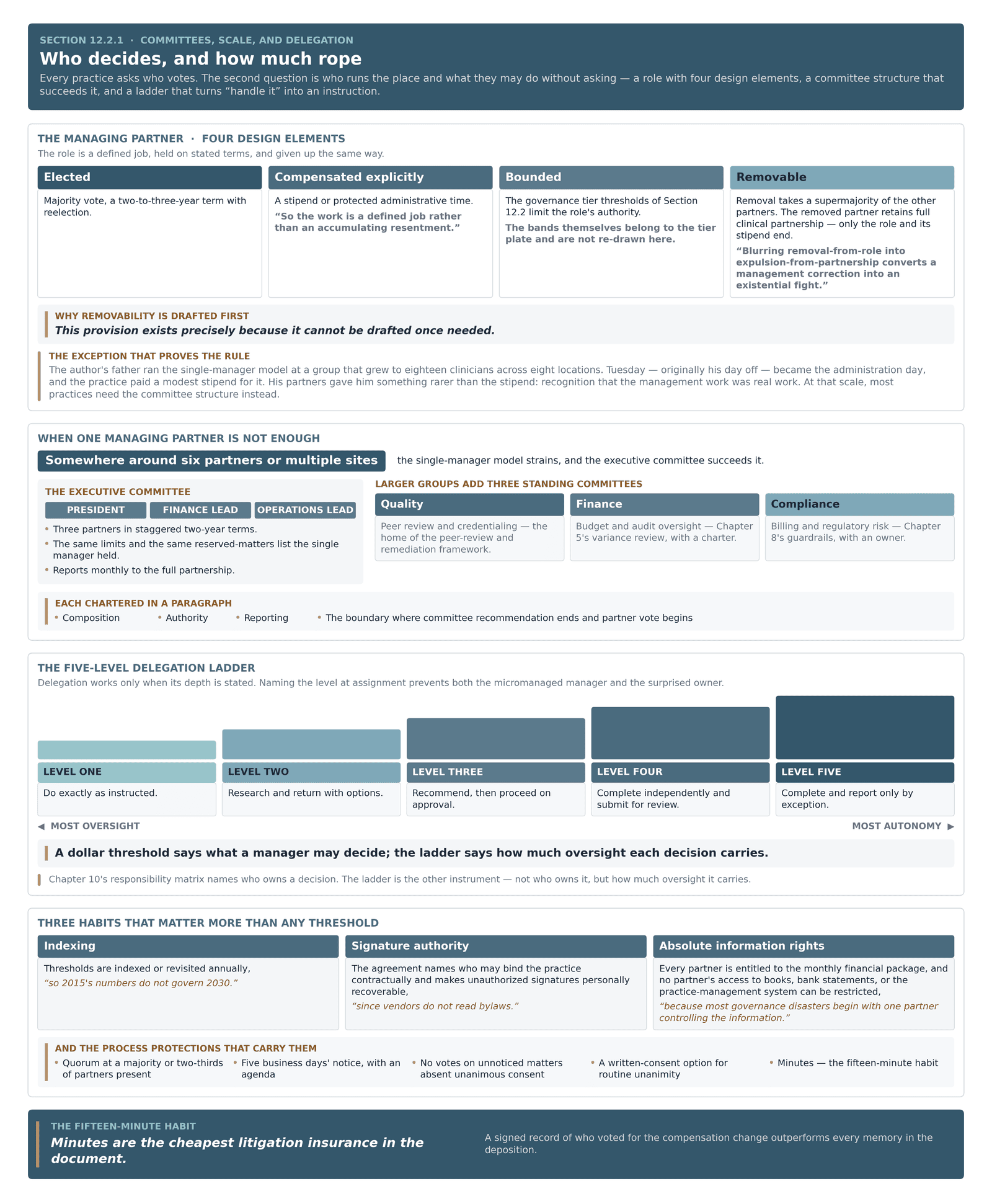
Growth breaks informal governance on a predictable schedule. Somewhere around six partners or the second location, the single-manager model strains, and the successor structure is an executive committee: three partners in staggered two-year terms—president, finance lead, operations lead—holding the same dollar limits and the same reserved-matters list the managing partner held, and reporting monthly to the full partnership. Staggering the terms is what keeps institutional memory in the room when one seat turns over.
Larger groups add standing committees on top of that, and three earn their charters in nearly every practice that reaches the size to need them.
Quality owns peer review, credentialing, and clinical performance oversight. This is the committee practices most want to avoid building, because the work is uncomfortable and the alternative—handling clinical concerns through hallway conversation—feels kinder. It is not kinder. A formal framework documents concerns, delivers them to the physician in question, allows a defined opportunity to correct, and creates a record of what the practice actually did. That record is what protects the physician who improves, and it is the only thing that makes the removal machinery of article 40 legitimate if improvement never comes. Peer-review confidentiality is governed by state statute and the protections vary considerably; whether and how a practice’s process qualifies is a question for counsel, answered while the committee is being chartered rather than during its first hard case. Credentialing belongs here too: primary source verification, payer enrollment status, board certification, and the license and privilege expirations that quietly convert a partner into a clinician the practice cannot bill for.
Finance owns budget development, variance review, capital planning, and audit oversight. The chronic failure mode is a finance committee with a title and no authority—a group that reviews numbers, forms opinions, and refers everything to the full partnership anyway. Charter it with real work: the committee builds the annual budget and brings it for approval, reviews monthly variance against it, reviews capital requests before they reach the partners, and oversees the practice’s financial controls, including the reconciliation of the billing system to the bank that nobody enjoys and every practice needs. Give it the standing agenda and it becomes the reason partner meetings get shorter.
Compliance owns billing compliance, regulatory risk, and investigation response. The value here is having an owner at all. Coding audits, documentation standards, the response to a payer audit letter, breach notification, and the practice’s written compliance program need a named partner accountable for them, because “everyone’s responsibility” is the compliance posture auditors feast on. Route findings to the partners rather than around them: a compliance question that goes directly from an administrator to outside counsel and never surfaces at a partner meeting has left the owners carrying exposure they cannot see.
Whatever committees a practice builds, charter each one in a paragraph and put the paragraph in the agreement or the bylaws. Four elements do the work. Composition—how many, who selects them, what terms they serve. Authority—what the committee may decide on its own and what dollar or subject limits bound it. Reporting—to whom, how often, in what form. And the boundary, which is the element most charters omit and the one that causes every dispute: exactly where committee recommendation ends and partner vote begins. A committee that believes it may act and a partnership that believes it may only advise will find out at the worst possible moment.
Two related requirements make committees useful rather than decorative. Put quarterly and annual performance reviews on the calendar with defined key performance indicator thresholds, so committee work has a scoreboard—collections, days in accounts receivable, visit volume, payer mix, staffing ratios, and whatever else the practice actually manages against. And require partner cooperation with periodic operational and benchmarking assessments in the agreement itself. Practices that engage an outside assessment discover that the partner most in need of the findings is occasionally the partner declining to schedule the interview. Cooperation drafted in advance is cheap; cooperation requested during a crisis reads as an accusation.
One more instrument keeps delegation honest. A five-level ladder turns “handle it” into an instruction: do exactly as instructed; research and return with options; recommend, then proceed on approval; complete independently and submit for review; complete and report only by exception. Naming the level when a committee or a manager takes an assignment prevents both the micromanaged administrator and the surprised owner.
Committees do not replace partner governance. They prepare it. The reserved-matters catalog stays with the partners, the tier framework still assigns every decision its threshold, and no charter may quietly relocate a fundamental decision into a subcommittee of three. What committees buy is distributed work, documented process, and accountability that does not depend on one person’s memory. Once a practice reaches the size where those things matter, the choice is not between committees and simplicity. It is between committees and drift.
Red flags. No formal committee structure at a size that clearly requires one, with governance concentrated in whoever is willing to do it. Peer review conducted informally, with nothing documented and nothing protected. A finance committee that exists on the org chart and decides nothing. Compliance issues routed directly to outside counsel without partner visibility. Committee membership, terms, and authority left undefined. And charters that never name the boundary between recommendation and vote.
Good governance does not happen by accident. It happens by charter.
Committee governance red flags
- No formal committee structure at a size that clearly requires one, with governance concentrated in whoever is willing to do it.
- Peer review conducted informally, with nothing documented and nothing protected.
- A finance committee that exists on the org chart and decides nothing.
- Compliance issues routed directly to outside counsel without partner visibility.
- Committee membership, terms, and authority left undefined.
- Charters that never name the boundary between recommendation and vote.
Frequently asked questions
When does a practice need governance committees?
At four partners everything gets decided at dinner; at seven, dinner takes three hours and settles nothing; at twelve, one managing partner quietly absorbs decisions nobody voted to give her. Somewhere around six partners or the second location, the single-manager model strains, and the successor structure is an executive committee of three in staggered two-year terms.
What belongs in a committee charter?
Four elements do the work. Composition: how many members, who selects them, what terms they serve. Authority: what the committee may decide on its own, and what dollar or subject limits bound it. Reporting: to whom, how often, in what form. And the boundary, naming exactly where committee recommendation ends and partner vote begins.
What do quality, finance, and compliance committees own?
Quality owns peer review, credentialing, and clinical performance oversight, and the record it creates protects the physician who improves. Finance owns budget development, variance review, capital planning, and audit oversight. Compliance owns billing compliance, regulatory risk, and investigation response, with findings routed to the partners rather than around them.
Put the agreement to the test
The Partnership Agreement Analyzer scores an existing agreement against the framework this series is built on — or schedule a discovery call to work through it with PMI. The full framework, with the arithmetic, lives in the textbook Pediatric Practice Management: The Fundamentals.