
A physician non-compete restrains where a departing partner may practice, and whether it operates is a question of state law that shifts session by session. Radius and duration are scaled to the market rather than to anxiety, the covenant lives in both the employment and equity documents, and where statutes narrow the restraint, liquidated damages price the harm instead.
The signature is on the page. Whether it means anything depends on which state the practice sits in, which judge hears the case, how the clause was drafted, and whether the covenant was given as a condition of employment or as part of an equity transaction. Physician non-competes are among the most litigated provisions in healthcare, and among the most confidently misunderstood. Partners quote them at each other as though they were self-executing. They are not.
A restrictive covenant asks a court to restrain a licensed professional from earning a living in her field, and courts approach that request warily. Where non-competes are permitted at all, the inquiry generally runs through a familiar sequence: does the practice have a legitimate interest to protect, is the restraint no broader than that interest requires in geography, duration, and scope, and does enforcing it harm the public. That last factor carries unusual weight in pediatrics. A county with four pediatricians and a covenant that removes one of them is a different case from the same clause in a metropolitan market, and more than one court has said so.
The state map decides most of the argument before drafting begins. California, North Dakota, and Oklahoma have voided most employment non-competes by statute for many years. Minnesota barred them for agreements entered on or after July 1, 2023. A growing group of states—several of them with physician-specific statutes—limit duration, cap radius, require a buyout option, or void covenants for physicians outright, and those statutes change legislative session by legislative session. Nothing in this article substitutes for confirming the current rule in the state where the practice actually operates, and confirming it with healthcare counsel who watches that legislature. The list above is a starting point for a conversation, not the conclusion of one.
Federal policy has been in motion as well. The Federal Trade Commission issued a rule in 2024 that would have barred most non-competes nationally; a federal district court set it aside before its effective date, and the agency’s litigation and enforcement posture has continued to shift since. What that history establishes is not a rule to plan around but a condition to plan for: the federal answer is unsettled, the state answers are moving, and an agreement built on the assumption that a covenant signed today will read the same way in five years is built on sand. Draft so that the practice survives the covenant being narrowed.
Geography is where good drafting shows first. Define the restricted area in miles from specifically identified addresses, and say how the miles are measured—straight-line radius or driving distance produce materially different maps. “The county,” “the metropolitan area,” and “the practice’s service area” are invitations to litigate the definition before anyone reaches the merits. Scale the number to the market rather than to the anxiety. Five to ten miles and two years in a suburb reads very differently than 25 miles in a rural county, where a two-pediatrician office may be, functionally, the county’s pediatric infrastructure and the nearest alternative is 40 minutes away. And measure from the physician’s primary site rather than from every location the practice owns. A uniform 25-mile radius applied from each of four sites does not protect four practices. It fences a physician out of an entire region, and that is the design most likely to draw a challenge—and to deserve one.
Duration follows the same logic. One to two years is the band most commonly drafted and most commonly sustained where such covenants are permitted at all. Five years is not a longer version of the same clause; it is a request to have the provision struck, and in some jurisdictions to have the entire covenant struck with it. Scope is the third dimension and the one most often over-drafted. The covenant should restrict what the practice actually sells, which for most readers is outpatient general pediatrics. A clause barring “the practice of medicine” bars hospitalist shifts, utilization review, telehealth for a distant employer, and urgent care in another specialty—restraints far broader than any interest the practice can articulate.
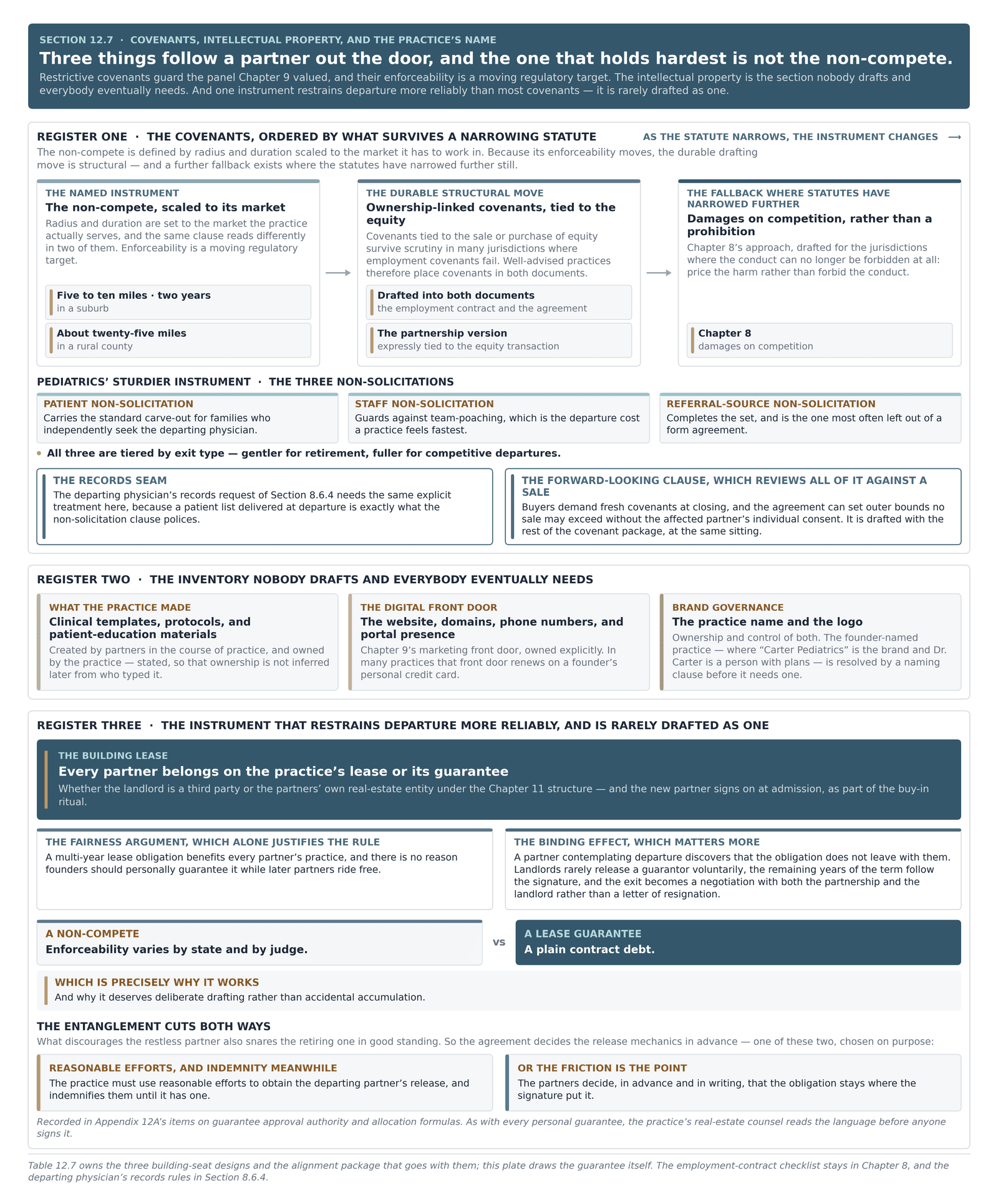
The ownership distinction is the most useful structural move available, and it is the one most agreements miss. A covenant given as a condition of employment and a covenant given in connection with the purchase or sale of an ownership interest are evaluated differently across many jurisdictions, and the distinction recurs in state statutes and in federal rulemaking alike. Well-advised practices therefore place covenants in both documents, with the partnership version expressly tied to the equity transaction—the covenant is consideration for what the buyer paid or the seller received, and the drafting says so on its face. Whether that structure holds in any particular state is, again, a question for counsel. What is certain is that a practice with the covenant in only one document has one argument, and a practice with it properly placed in both has two.
Then decide what happens when a court finds the clause too broad. States differ sharply. Some courts reform an overbroad covenant to reasonable terms. Some strike only the offending words and enforce the remainder. Some void the covenant entirely and leave the practice with nothing. Which rule applies determines whether over-drafting is a free option or a fatal one, and it is not a detail a template can guess. Include a severability and savings clause so the rest of the agreement survives the loss of one provision—but do not draft the covenant as though the savings clause will rescue it.
Where statutes or courts have narrowed traditional covenants past usefulness, the fallback is to price the harm rather than forbid the conduct. A damages-on-competition provision, a repayment of defined recruitment or ramp-up costs, or a buyout right can accomplish some of what a covenant was meant to accomplish, in a form courts treat as a contract question rather than a restraint-of-trade question. These provisions have their own limits and their own drafting traps, and they are jurisdiction-dependent too. Last, watch the boilerplate. A governing-law clause pointing at a state that voids physician non-competes, in an agreement signed by a physician practicing somewhere else, is a coin flip conducted years in advance—courts frequently apply the law of the state with the strongest interest in the dispute, whatever the contract says.
Red flags. A radius defined as “the county” or “the practice’s service area.” Duration set at five years. No distinction drawn between the employment covenant and the ownership covenant. An agreement governed by the law of a state that prohibits physician non-competes. No savings clause—or a savings clause doing work the covenant should have done itself. And a covenant last reviewed before the practice opened its second and third locations.
A covenant that cannot be enforced is not protection. It is the feeling of protection, purchased at the price of the meeting that could have produced the real thing.
Red Flags in a Physician Non-Compete
- A radius defined as the county or the practice’s service area rather than miles from identified addresses.
- Duration set at five years.
- No distinction drawn between the employment covenant and the ownership covenant.
- An agreement governed by the law of a state that prohibits physician non-competes.
- No savings clause, or a savings clause doing work the covenant should have done itself.
- A covenant last reviewed before the practice opened its second and third locations.
Frequently asked questions
Are physician non-competes enforceable?
Enforceability is a question of state law and judicial temperament rather than a given. California, North Dakota, and Oklahoma have voided most employment non-competes by statute; Minnesota barred them for agreements entered on or after July 1, 2023; and a growing group of states impose physician-specific limits. Those statutes change legislative session by legislative session, so healthcare counsel in the practice’s own state confirms the current rule.
How large a non-compete radius is typical for a medical practice?
Radius is scaled to the market rather than to the anxiety. Five to ten miles and two years reads very differently than 25 miles in a rural county, where a two-pediatrician office may be the county’s pediatric infrastructure. Careful drafting defines the area in miles from specifically identified addresses, states whether miles are straight-line or driving distance, and measures from the physician’s primary site.
What happens if a court finds a non-compete too broad?
States differ sharply. Some courts reform an overbroad covenant to reasonable terms, some strike only the offending words and enforce the remainder, and some void the covenant entirely and leave the practice with nothing. Which rule applies determines whether over-drafting is a free option or a fatal one, and it is not a detail a template can guess.
Put the agreement to the test
The Partnership Agreement Analyzer scores an existing agreement against the framework this series is built on — or schedule a discovery call to work through it with PMI. The full framework, with the arithmetic, lives in the textbook Pediatric Practice Management: The Fundamentals.