
Voting rights work when every decision is sorted into three tiers. Operational questions move on one partner's authority, significant ones take a defined majority, and fundamental ones — admitting a partner, selling, dissolving — require a supermajority. Dollar bands assign the gray areas, and quorum and voting weight are defined before the first contested vote needs them.
The equipment arrives on a Tuesday. It costs $200,000, it was ordered six weeks earlier, and the first two partners learn of it when the delivery truck blocks the parking lot. Nobody breached anything, because the agreement never said a purchase of that size required a vote. Governance without defined voting rights is not governance. It is whoever moves first.
Two questions organize the entire subject. How much consensus should a given decision cost? And who counts as consensus? Agreements that answer the first without the second, or the second without the first, leave exactly the gap the delivery truck drove through.
Start with the cost of consensus, because it is the more practical of the two. Sort every decision the practice makes into three tiers. Operational decisions belong to the managing partner or administrator: day-to-day spending under a stated threshold, staff management below the clinician level, scheduling, and vendor operations. For a typical single-site practice the dollar bands run to $10,000 of unilateral authority, with a notice-and-objection band from $10,000 to $50,000 in which spending proceeds after five business days’ notice unless a partner objects. Above $50,000, a vote is mandatory. Significant decisions take a partner vote at simple majority: budgets, clinician hiring and termination, payer contract execution, new service lines, leases within bounds, compensation-plan parameters, and expenditures above the threshold. Fundamental decisions take a supermajority of two-thirds or 75 percent, and they make up the reserved-matters catalog.
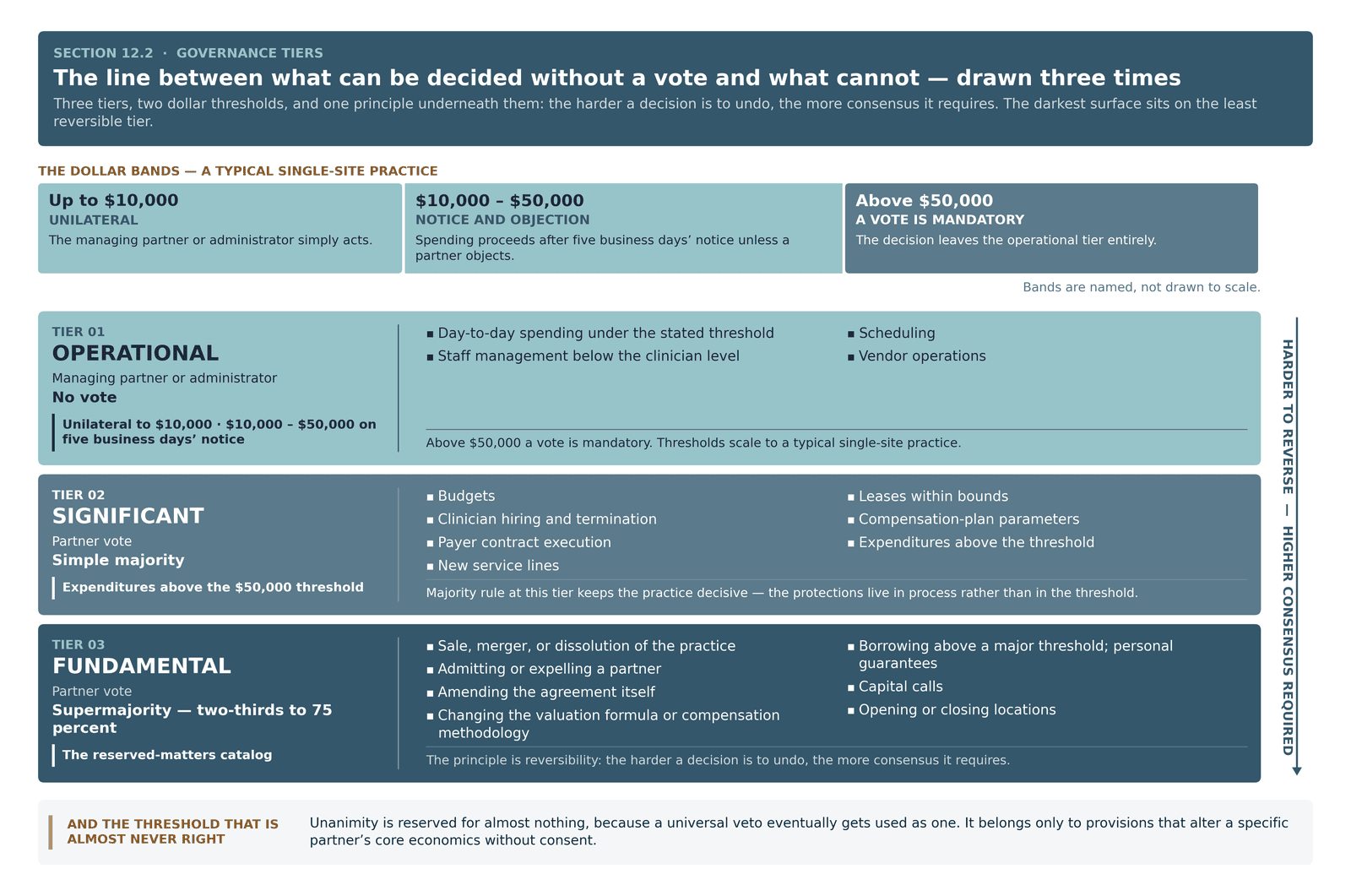
That catalog is short and worth writing out in full:
- Sale, merger, or dissolution of the practice, including any transaction transferring control to a private-equity platform or hospital system
- Admitting a new partner, or expelling an existing one
- Amending the partnership agreement itself
- Changing the valuation formula or the compensation methodology
- Borrowing above a stated threshold, issuing personal guarantees, or pledging practice assets
- Issuing a capital call
- Opening or closing a location
The principle beneath the tiers is reversibility: the harder a decision is to undo, the more consensus it should require. Unanimity is reserved for almost nothing, because a universal veto eventually gets used as one—the deadlock of article 1 was a unanimity requirement wearing the phrase “mutual consent.” Unanimity belongs only to provisions that alter a specific partner’s core economics without her consent.
Three habits matter more than the thresholds themselves. Index the dollar bands, or revisit them annually, so numbers set in 2015 do not govern 2030. Name who may bind the practice contractually, and make unauthorized signatures personally recoverable, because vendors do not read bylaws. And guarantee absolute information rights: every partner receives the monthly financial package, and no partner’s access to books, bank statements, or the practice-management system may be restricted. Most governance disasters begin with one partner controlling the information.
Now the second question, which decides what a threshold actually means. Per capita voting gives one partner one vote. Percentage voting weights ownership. Blended designs count most matters per capita and reserve percentage counting for a short list of ownership-level events. Either explicit choice beats silence, which hands the question to a state default statute that answers generically and, for most practices, wrongly.
Then stress-test the design by translating every threshold into names before adoption. Take a six-partner practice with percentage voting, a 55 percent founder, and five partners at 9 percent each. A simple majority is the founder alone—one person constitutes a majority, and the other five together can neither carry a vote nor block one. Two-thirds is the founder plus any two, and 75 percent is the founder plus any three; in both cases the founder must be one of them, which means she holds a permanent veto over every fundamental decision the practice will ever face. Count the same roster per capita and a simple majority takes four of six, two-thirds takes the same four, and 75 percent takes five. The arithmetic of a three-partner practice is more startling still: simple majority is two of three, two-thirds is also two of three—the same two people—and 75 percent is unanimity by another name. PMI has run that translation for partners who were certain their thresholds worked, and the names on the page are regularly a surprise. Retranslate at every admission, because a threshold that made sense at four partners means something different at six.
Process protections carry as much weight as thresholds, and they are cheaper. Set a quorum—a majority or two-thirds of partners present—so a meeting convened during a colleague’s parental leave cannot quietly become the meeting that decides her compensation. Require five business days’ notice with an agenda, and prohibit votes on unnoticed matters absent unanimous consent. Provide a written-consent option for routine unanimity so the practice is not held up waiting for a meeting. And keep minutes. Fifteen minutes of notes is the cheapest litigation insurance in the document, because a signed record of who voted for the compensation change outperforms every memory in a deposition.
Two refinements finish the design. Part-time partners need a stated rule rather than a shrug: the common resolution gives full votes on fundamental matters and full-time-equivalent-weighted votes on operating ones. And absence rules should settle whether proxies are permitted and whether a partner on extended leave retains her votes—decided in advance, before the leave that makes the question personal.
Red flags. No differentiation between routine and major decisions. A managing partner whose authority is undefined and who can therefore bind the practice on anything. No supermajority requirement for a sale or for major debt. Part-time partners voting at the same weight as full-time partners with no one having decided that they should. And quorum left undefined, which makes every contested vote’s validity an argument waiting to happen.
Undefined authority is not freedom. It is a governance time bomb, and it always goes off on a Tuesday.
Voting Rights Red Flags
- No differentiation between routine and major decisions.
- A managing partner whose authority is undefined and who can therefore bind the practice on anything.
- No supermajority requirement for a sale or for major debt.
- Part-time partners voting at the same weight as full-time partners with no one having decided that they should.
- Quorum left undefined, which makes every contested vote's validity an argument waiting to happen.
| Tier | Decisions covered | Dollar band | Vote required |
|---|---|---|---|
| Operational | Day-to-day spending, staff management below the clinician level, scheduling, and vendor operations | Under $10,000 | Managing partner or administrator, acting unilaterally |
| Operational, notice band | The same operational spending, with the partners notified before it proceeds | $10,000 to $50,000 | Proceeds after five business days' notice unless a partner objects |
| Significant | Budgets, clinician hiring and termination, payer contract execution, new service lines, leases within bounds, and compensation-plan parameters | Above $50,000 | Simple majority of partners |
| Fundamental | Reserved matters: sale, merger, or dissolution; admitting or expelling a partner; amending the agreement; changing the valuation formula or compensation methodology; borrowing above a stated threshold, personal guarantees, or pledging assets; capital calls; opening or closing a location | Not threshold-based | Supermajority of two-thirds or 75 percent |
Frequently asked questions
What decisions require a supermajority vote in a medical practice?
The reserved-matters catalog: sale, merger, or dissolution, including any transaction transferring control to a private-equity platform or hospital system; admitting a new partner or expelling an existing one; amending the partnership agreement; changing the valuation formula or the compensation methodology; borrowing above a stated threshold or pledging practice assets; issuing a capital call; and opening or closing a location.
How much can a managing partner spend without a vote?
For a typical single-site practice the dollar bands run to $10,000 of unilateral authority. From $10,000 to $50,000 a notice-and-objection band applies, in which spending proceeds after five business days' notice unless a partner objects. Above $50,000, a vote is mandatory. The bands are indexed or revisited annually so old numbers do not govern indefinitely.
Should partners vote per capita or by ownership percentage?
Per capita voting gives one partner one vote, percentage voting weights ownership, and blended designs count most matters per capita while reserving percentage counting for ownership-level events. Either explicit choice beats silence, which hands the question to a state default statute. Practices translate every threshold into names before adoption, and retranslate at each admission.
Put the agreement to the test
The Partnership Agreement Analyzer scores an existing agreement against the framework this series is built on — or schedule a discovery call to work through it with PMI. The full framework, with the arithmetic, lives in the textbook Pediatric Practice Management: The Fundamentals.