
Railroad rails hold a fixed gauge all the way to the destination — they never converge into one rail, and a small divergence derails the train miles later, at speed. Partnership alignment works the same way: not sameness, but fidelity to a shared gauge, kept decision by decision through the four ways a group says yes.

Standard railroad gauge in North America is 4 feet 8.5 inches, measured rail to rail, and the tolerance on mainline track is measured in fractions of an inch. What makes the number interesting is not its precision but its consequence structure. A rail that drifts out of gauge does not announce itself in the switchyard. At walking speed, nothing happens. The failure arrives miles down the line, at speed, at the exact moment when correction is no longer available. The divergence and the derailment are separated by so much distance that the crew at the scene of the wreck rarely thinks to blame a millimeter.
Physician partnerships fail on the same schedule. Almost none derail at the signing. The misalignment that ends a practice is measured in millimeters at the founding — a slightly different assumption about workload, a quietly different picture of retirement, two compatible-sounding answers to the question of what the practice is for — and it is measured in attorneys' fees a decade later. The distance between the divergence and the wreck is what makes the wreck feel unforeseeable. It never was. It was in gauge drift the whole time.
This is why the claim that partners need 100 percent alignment is both correct and routinely misunderstood. The misunderstanding is to hear it as a demand for sameness — identical opinions, identical instincts, identical answers to every operating question. No partnership has ever run on that, and none needs to. Two rails never touch. They never converge into a single rail, and nothing about the train requires them to. What the train requires is that they hold a fixed relationship to each other, without exception, for the entire length of the line. Alignment among partners is the same property. It is not agreement on everything. It is total fidelity to a shared gauge, and the gauge has exactly three rails' worth of content: where the practice is going, how the partners turn disagreement into decisions, and the commitment that a decision, once made, is carried by every partner at full weight — including the partners who argued against it. On those three, alignment must be 100 percent. On nearly everything else, partners are allowed to be what they are: two different rails, running in parallel.
The reason partial alignment fails is arithmetic rather than character. A one-degree divergence is invisible over a week and unmistakable over a decade, because divergence compounds with distance. The call-schedule inequity nobody revisits, the compensation formula one partner privately re-derives every December, the growth question that gets deferred because raising it feels like conflict — each is a millimeter. Practices do not fail over the big fight. The big fight is the last inch of a divergence that had been widening, quietly and politely, for years.
Four ways a group says yes
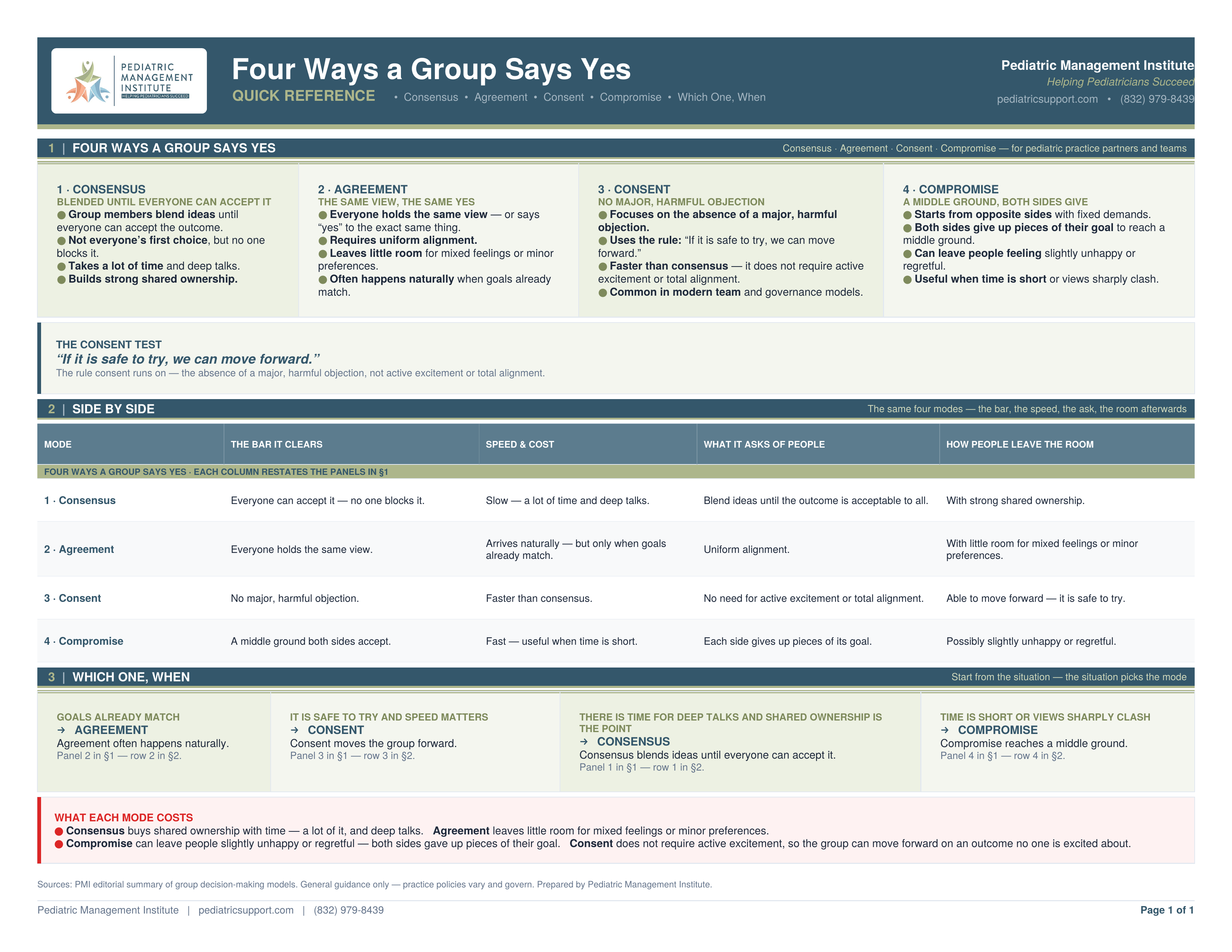
Alignment, then, is not a mood or a founding condition. It is built and rebuilt decision by decision, and a group has more than one way to say yes. There are four — agreement, consent, consensus, and compromise — and knowing which one a given decision calls for is itself a governance skill, as consequential as anything in the compensation formula.
Agreement is everyone holding the same view — saying yes to the exact same thing. It requires uniform alignment and leaves little room for mixed feelings, which is why it cannot be manufactured; it happens naturally when goals already match. When it shows up, a practice should take the gift and skip the process. The mistake is demanding it everywhere. A partnership that requires agreement on every question has quietly adopted governance by unanimity, and unanimity in a small group has a failure mode with a name: deadlock. One two-pediatrician practice ran for a decade on a governance section that read, in its entirety, "decisions shall require mutual consent" — which worked until a hospital's acquisition offer arrived and the partners, for the first time, wanted different things. Every vote tied. Fourteen months of paralysis and roughly $235,000 later, the offer had lapsed unanswered. Demanding uniform alignment on every question is how a practice ends up with none.
Consent asks a much narrower question: not "does everyone love this?" but "does anyone see a major, harmful objection?" Its operating rule is simple — if it is safe to try, the group can move forward — and it is faster than consensus precisely because it does not require active excitement or total alignment. Consent is the workhorse mode for the reversible decisions that fill a practice's calendar: the scheduling pilot, the vendor trial, the new patient-communication workflow. Most operating decisions are safe to try, and treating them as safe to try is what keeps the train moving between partner meetings.
Consensus is the expensive mode, and the expense is the point. Partners blend ideas until everyone can accept the outcome — not everyone's first choice, but nothing anyone blocks — and getting there takes time and deep talks. What the time purchases is strong shared ownership, which is why consensus belongs to the identity-grade decisions: the partnership agreement itself, admitting a partner, selling the practice, anything the group will have to execute together for years. A decision that needs every partner's full weight in execution is worth every partner's full voice in formation.
Compromise is the mode of last resort, and it deserves an honest description. It starts from opposite sides holding fixed demands, and both sides give up pieces of their goal to reach a middle ground. It is useful when time is short or when views sharply clash — and it can leave both sides slightly unhappy, because each remembers what it surrendered. A practice that reaches for compromise occasionally, under a deadline, is using the tool correctly. A practice that compromises on its fundamentals has installed regret at the center of its governance and should expect the argument to return.
Write the modes into the agreement
The four modes stop being personality and become procedure at exactly one place: the partnership agreement. A well-drafted agreement already assigns a decision mode to every class of decision — it simply uses voting language to do it. Operational decisions delegated to a manager or a managing partner are consent-shaped: anyone may raise a harmful objection, and absent one, the practice moves. Significant decisions carried by a defined majority accept that agreement will not always exist and provide a way to decide anyway. Fundamental decisions — admission, sale, dissolution, amendment — sit behind a supermajority precisely because they are consensus-grade: decisions that fail in execution unless nearly everyone owns them. Sorting the practice's decisions into those tiers, in writing, before any particular decision is at stake, is the single most durable act of alignment available to a partnership.
And like track, alignment is maintained on a schedule rather than assumed. Railroads do not inspect rail because they expect failure; they inspect because drift is silent. A partnership audits its agreement annually for the same reason — two hours a year to confirm the destination still matches, the decision rules still fit the roster, and the commitments still carry every signature's weight. Gauge is not a founding measurement. It is a maintained one.
The train does not derail where the rails begin to diverge. It derails miles later, at speed, where no correction is possible. The time to check the gauge is now, while the divergence is still a millimeter — and while checking it is still a conversation between partners rather than a negotiation between counsel.
Signals the rails are drifting
- Decisions postponed because no one knows how they are supposed to be decided.
- The same disagreement resurfacing every quarter, unresolved and unchanged.
- A partner who has stopped arguing — silence is not consent; consent is the absence of a harmful objection, stated out loud.
- Every question, large or small, treated as requiring unanimity.
- Compromise operating as the default mode rather than the last resort.
Frequently asked questions
Do practice partners need to agree on everything?
No — and demanding agreement on everything is a governance failure in its own right, because it converts every decision into a unanimity requirement and every tie into paralysis. Partners need 100 percent alignment on three things: the destination, the rules for turning disagreement into decisions, and the commitment to carry a decision once made. Beyond those, differing views are the normal condition of a healthy partnership.
What is the difference between consensus and consent?
Consensus blends ideas until everyone can accept the outcome, which takes time and buys shared ownership. Consent asks only whether anyone sees a major, harmful objection — if a choice is safe to try, the group moves forward. Consent is faster because it requires neither enthusiasm nor total alignment, which makes it the right mode for reversible operating decisions.
How does a practice decide which decision mode to use?
By writing the assignment into the partnership agreement before any particular decision is at stake. Operational decisions run on delegated, consent-shaped authority; significant decisions carry a defined majority; fundamental decisions — admission, sale, dissolution, amendment — sit behind a supermajority because they are consensus-grade. The tiering is the alignment.
Put a number on the agreement
The Partnership Agreement Analyzer scores an existing agreement against the framework this series is built on — or schedule a discovery call to work through it with PMI. The full framework, with the arithmetic, lives in the textbook Pediatric Practice Management: The Fundamentals.