
The managing partner is the operational hub of most medical practices. The role holds together on four elements: election to a stated term, explicit compensation, authority with defined limits, and removal by supermajority — a separate act from expulsion. Around six partners, the individual gives way to a committee.
A four-physician group decides, after two difficult years, that it needs a different managing partner. The partners agree on that much. Then someone opens the agreement to find the removal procedure and discovers there is none—no term, no election, no removal vote, nothing but a role that accreted to whoever was willing to answer the bank’s phone calls a decade ago. Replacing him now requires either his consent or a lawsuit. The group spends 18 months getting to a result that a single paragraph would have produced in one meeting.
The managing partner is the operational hub of most medical practices. The role runs vendor relationships, oversees the administrator and the staff structure, signs what the practice buys, sits across from payers and the bank, and sets the agenda for the meetings where governance actually happens. It is real work, done on time that would otherwise be clinical, and it is the job most likely to be simultaneously indispensable and undefined. Left undefined, it drifts to one of two failure states: toothless, so that nothing gets decided between meetings, or autocratic, so that everything does.
Four design elements make the role work, and all four belong in the agreement:
- Elected. By majority vote, to a stated term of two to three years, with a defined reelection process.
- Compensated explicitly. A stipend, protected administrative time, or both—disclosed to every partner, so the work is a defined job rather than an accumulating resentment.
- Bounded. The governance tiers of article 6 set the limits: what may be decided alone, what proceeds on notice, and what requires a vote.
- Removable. By supermajority of the other partners, with the removed partner retaining full clinical partnership.
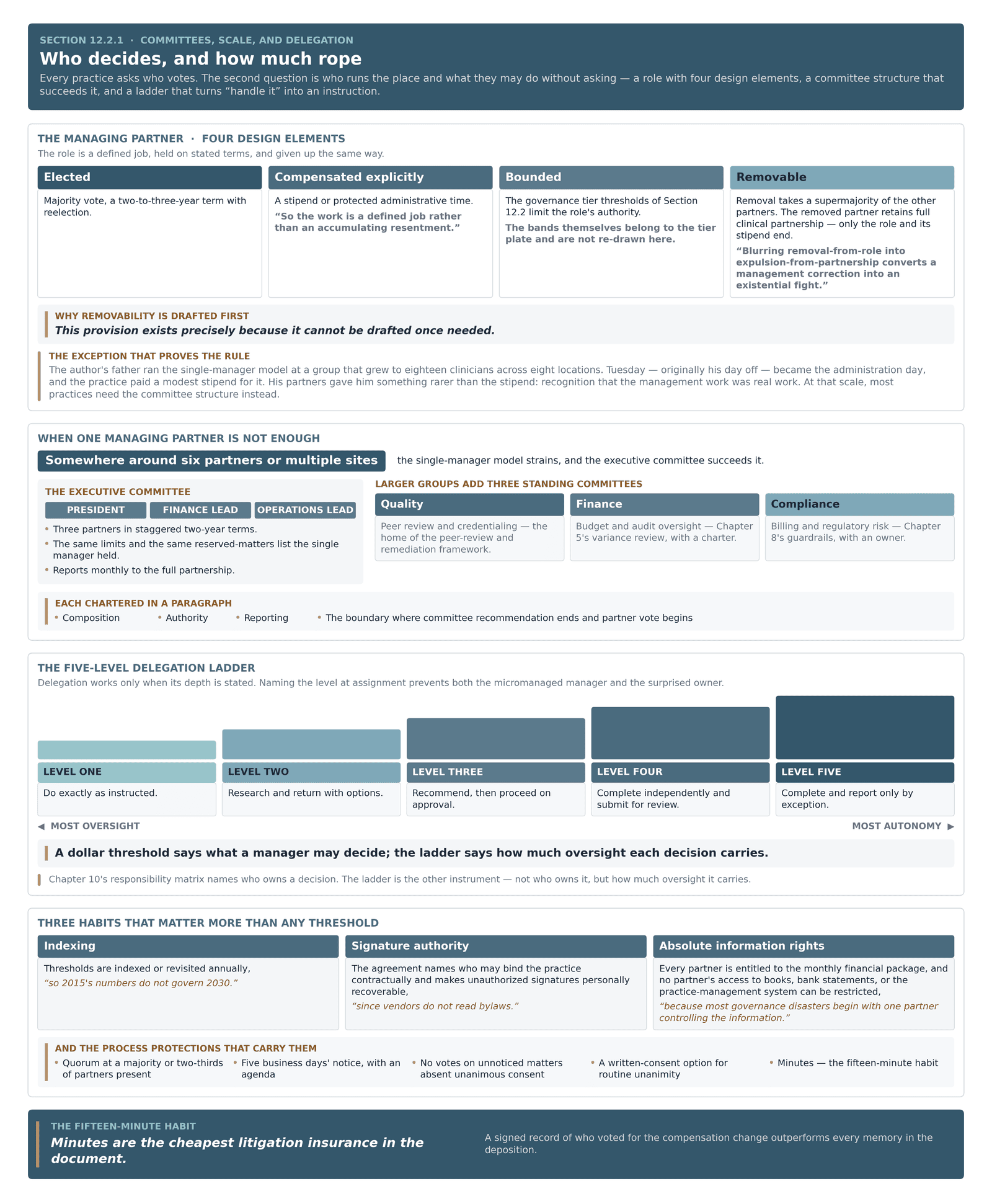
That last element deserves the most attention, because it is the one that cannot be drafted once it is needed. Removal must be possible on a supermajority of the other partners rather than on unanimity, since a unanimity requirement means the managing partner votes on his own removal and the provision is decorative. And removal from the role must be cleanly separated from expulsion from the partnership. Blurring the two converts a management correction into an existential fight, which is why groups without the distinction avoid the conversation for years while the problem compounds. The removed partner keeps her equity, her patients, and her seat at the table. Only the role and its stipend end.
Compensation for the role should be a number the other partners can see. A stipend nobody discusses becomes, in the retelling, whatever the least generous partner imagines it to be. And protected administrative time is often the more valuable half of the package, because the alternative is a physician doing the practice’s administrative work in the hours between charting and dinner, which is how practices lose managing partners and then discover how much the role was carrying.
Signature authority needs its own sentence, and it is the sentence that limits real exposure. The agreement names which partners may bind the practice contractually or financially, states the dollar limits attached to each, and provides that unauthorized signatures are personally recoverable. Vendors do not read bylaws. A three-year equipment lease signed by a partner with no authority to sign it is, from the vendor’s side of the table, simply a lease, and the practice’s remedy runs against the colleague who signed rather than against the counterparty.
Scale eventually outgrows the single-manager model. Somewhere around six partners or multiple sites, one person can no longer hold operations, finance, and personnel at once, and the executive committee succeeds the individual: three partners in staggered two-year terms—commonly a president, a finance lead, and an operations lead—holding the same dollar limits and the same reserved-matters list, and reporting monthly to the full partnership. Staggering the terms is what preserves institutional memory through turnover. Larger groups add standing committees, each chartered in a single paragraph stating composition, authority, reporting line, and the boundary where committee recommendation ends and partner vote begins. Quality handles peer review and credentialing. Finance takes budget and audit oversight. Compliance owns billing and regulatory risk.
The model can hold longer than the rule suggests where the partners support it properly. One group ran to 18 clinicians across eight locations under a single managing partner whose Tuesday—originally his day off—became his administration day. The practice paid him a modest stipend, and his partners gave him something rarer than the stipend: recognition that the management work was real work. The protected day and the recognition were what made it durable. Most groups at that scale need the committee structure.
Whatever the structure, delegation works only when its depth is stated, and a five-level ladder turns “handle it” into an instruction. Level one: do exactly as instructed. Level two: research and return with options. Level three: recommend, then proceed on approval. Level four: complete independently and submit for review. Level five: complete and report only by exception. Naming the level at assignment prevents both the micromanaged administrator and the surprised owner. A dollar threshold says what a manager may decide; the ladder says how much oversight each decision carries.
Then guard against authority creep, which is the slow version of the problem this article opened with. Authority creep happens one reasonable exception at a time, and each exception becomes the precedent for the next. The remedy is an annual review of the role against its written scope, calendared alongside the practice’s other governance maintenance, at which the partners confirm that the decisions actually being made unilaterally are the decisions the agreement says may be.
Red flags. A managing partner role that exists in practice but not in the document, with authority assumed rather than granted. No term limit and no reelection process. Removal requiring a unanimous vote, which is removal in name only. Compensation for the role undisclosed to the other partners. And major decisions being made without a vote because that is how they have always been made.
Power without accountability is not leadership. It is a liability with a parking space.
How to Structure the Managing Partner Role
- Elect the managing partner by majority vote to a stated term of two to three years, with a defined reelection process.
- Compensate the role explicitly with a stipend, protected administrative time, or both, disclosed to every partner.
- Bound the authority by the governance tiers: what may be decided alone, what proceeds on notice, and what requires a vote.
- Make the role removable by supermajority of the other partners, with the removed partner retaining full clinical partnership.
- Name which partners may bind the practice, with dollar limits, and make unauthorized signatures personally recoverable.
- Review the role annually against its written scope to catch authority creep before each exception becomes precedent.
Frequently asked questions
How do partners remove a managing partner?
By supermajority of the other partners, stated in the agreement. Unanimity fails because it lets the managing partner vote on his own removal, which makes the provision decorative. Removal from the role stays cleanly separate from expulsion from the partnership: the removed partner keeps her equity, her patients, and her seat at the table. Only the role and its stipend end.
Should a managing partner be paid for the role?
Yes, and explicitly. A stipend, protected administrative time, or both, disclosed to every partner, so the work is a defined job rather than an accumulating resentment. A stipend nobody discusses becomes, in the retelling, whatever the least generous partner imagines it to be. Protected administrative time is often the more valuable half of the package.
When does a practice need an executive committee instead?
Somewhere around six partners or multiple sites, one person can no longer hold operations, finance, and personnel at once. The executive committee then succeeds the individual: three partners in staggered two-year terms, commonly a president, a finance lead, and an operations lead, holding the same dollar limits and reserved-matters list and reporting monthly to the full partnership.
Put the agreement to the test
The Partnership Agreement Analyzer scores an existing agreement against the framework this series is built on — or schedule a discovery call to work through it with PMI. The full framework, with the arithmetic, lives in the textbook Pediatric Practice Management: The Fundamentals.