
Financial transparency is a structural property of ownership rather than a courtesy. The agreement specifies the monthly reporting package, the benchmarks it is measured against, and each partner's right to audit the inputs behind their own compensation — access written as an absolute, not negotiated when a number looks wrong.
A partner asks for the expense detail behind her compensation statement. She is told the report does not break out that way, that the administrator will walk her through it at some point, and that the allocation is the same one everybody gets. Each answer is delivered pleasantly. None of them is an answer. Three months later she is still asking, and the question has quietly changed from what the number is to why nobody wants her to see it.
That drift is the whole subject. Financial transparency in a partnership is not a courtesy extended by whoever runs the practice. It is a structural property of ownership, and where it is absent, every other governance provision degrades. Partners cannot vote on a budget they have not seen, cannot evaluate a managing partner whose numbers they cannot check, and cannot be held accountable for results they had no way to track. Most governance disasters in physician practices begin the same way: one partner controls the information.
So the agreement starts with an absolute. Every partner is entitled to the practice’s financial package, and no partner’s access to the books, the bank statements, the payroll records, or the practice-management system may be restricted for any reason. Not during a dispute. Not while a valuation is pending. Not while one partner is on leave. An information right that can be suspended at the moment it matters is not a right; it is a privilege with a nice name.
Then define what the package contains and when it arrives, because a right to unspecified information produces unspecified information. A workable monthly package is short enough that partners actually read it: an income statement with prior-year and budget comparatives, a balance sheet, the cash position, an accounts receivable aging, payer mix, provider-level productivity, and the expense allocation schedule with the methodology stated on its face. Quarterly, the practice adds a performance review against defined thresholds. Annually, it delivers accountant-prepared statements, the tax return, and the year’s reconciliation of allocations to actuals.
The quarterly review is where reporting becomes governance, and it works only when the numbers are read against something. Set the benchmarks in advance so a metric arrives with its own verdict attached: revenue per encounter, the well-visit ratio, days in accounts receivable, the net collection rate, the overhead rate computed on a stated method, and payer concentration, where exposure above roughly 30 percent of collections in a single payer is a risk the partners should be managing on purpose. A number without a threshold is trivia. A number with a threshold is a decision waiting to be made.
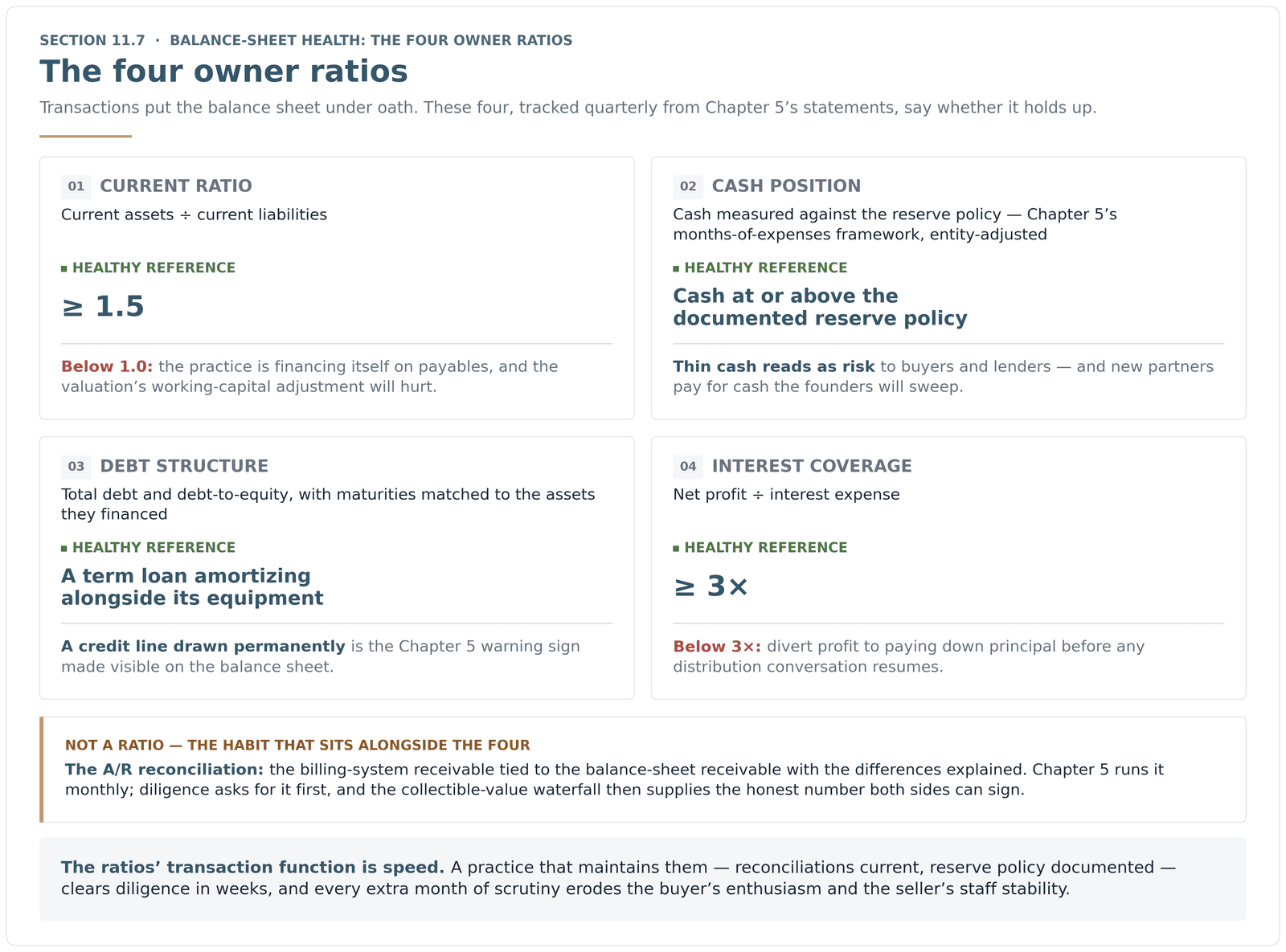
Reporting is only as sound as the reconciliation behind it. A financial package that has never been tied back to the bank is a set of assertions, however punctually it arrives. Require payments recorded in the billing system to be reconciled against deposited practice revenue on a stated cadence, and require that reconciliation to be performed or reviewed by someone outside the daily money flow. It is the highest-yield financial control available to a practice of this size, it catches posting errors while they are still correctable, and it is what separates a partner who is reading the practice from a partner who is reading a report about the practice.
Compensation formula audit rights come next, and they are narrower and more powerful than most partners realize. The right is not to audit a colleague’s pay. It is to verify the inputs to one’s own: the visit counts, the attribution of those visits to the rendering clinician, the collections credited, the expense allocation percentage, the overhead rate applied, and the arithmetic connecting all of it to the figure on the statement. The rule of thumb PMI hands every practice is blunt: any compensation formula a smart physician cannot recompute from the monthly package within 30 minutes is a resignation letter in escrow. A formula that requires a meeting to explain will eventually require a lawyer to defend.
Expense allocation transparency is the same right pointed at the cost side. The methodology is documented in writing, disclosed to every partner, and cannot be changed without notice and a vote. That last clause prevents the most common quiet injury in a multi-partner practice—an allocation basis that shifts a percentage point or two a year, each shift defensible on its own, none of them announced, until a partner reconstructs five years of statements and discovers her share of the fixed block grew by a third while her schedule did not. Article 15 works the overhead methodologies themselves.
Employed clinicians sit in a different position, and the agreement should say so rather than leave it to improvisation. A partner is an owner and gets the entity’s financials. An employed physician or advanced practice provider is not an owner and does not—but does get everything that feeds her own compensation: her productivity data, her attribution, her allocation, and the formula applied to them. Drawing that line explicitly protects both directions. It gives the employed clinician a real right to check her own pay, and it spares the practice the awkward moment when a productivity dispute becomes a demand for the partners’ distribution history.
Finally, build the escalation path, because occasionally a partner wants more than the standard package. A workable provision states how a request is made, the window in which the practice must respond, what the practice may charge for extraordinary work, and the partner’s right to engage an independent accountant at her own expense—with the cost shifting to the practice if the examination finds a material error. Bound it against abuse: a defined frequency, a confidentiality obligation, and no right to disrupt operations. A request procedure that exists makes most requests unnecessary, because the information asymmetry that generated the anxiety is gone.
Red flags. Financial reports circulating only to the managing partner and the administrator. Compensation formula inputs described as proprietary, or as too complicated to reproduce. Expense allocations that change year to year without notice or a vote. No defined benchmarks and no reporting cadence, so the practice’s performance is whatever the last conversation said it was. And the diagnostic red flag that stands for all the others: financial disputes that keep arising because one partner routinely knows things the others do not.
A practice that reports well argues about decisions. A practice that reports badly argues about the numbers—and never gets to the decision at all.
Building financial transparency into the agreement
- Guarantee every partner unrestricted access to the books, bank statements, payroll records, and the practice-management system, suspended for no reason.
- Define the monthly package and its delivery date, add a quarterly review, and deliver accountant-prepared statements and the tax return annually.
- Set benchmarks in advance so each metric arrives with a verdict: days in accounts receivable, net collection rate, overhead, payer concentration.
- Reconcile payments recorded in the billing system against deposited revenue on a stated cadence, reviewed by someone outside the daily money flow.
- Grant each partner the right to verify her own compensation inputs: visit counts, attribution, collections credited, allocation percentage, overhead rate, arithmetic.
- Document the expense allocation methodology, disclose it to every partner, and require notice and a vote before it changes.
- Build an escalation path: request procedure, response window, independent accountant at the partner’s expense, cost shifting where a material error appears.
Frequently asked questions
Can a practice restrict a partner’s access to the books during a dispute?
The agreement should start with an absolute: no partner’s access to the books, bank statements, payroll records, or the practice-management system may be restricted for any reason—not during a dispute, not while a valuation is pending, not while a partner is on leave. An information right that can be suspended when it matters is a privilege, not a right.
What belongs in a practice’s monthly financial package?
A workable monthly package stays short enough that partners read it: an income statement with prior-year and budget comparatives, a balance sheet, the cash position, an accounts receivable aging, payer mix, provider-level productivity, and the expense allocation schedule with its methodology stated on its face. Quarterly reporting adds a performance review against defined thresholds.
Do employed physicians get the same financial information as partners?
No. A partner is an owner and receives the entity’s financials. An employed physician or advanced practice provider is not an owner and does not—but does receive everything feeding her own compensation: productivity data, attribution, allocation, and the formula applied to them. Drawing that line keeps a productivity dispute from becoming a demand for the partners’ distribution history.
Put the agreement to the test
The Partnership Agreement Analyzer scores an existing agreement against the framework this series is built on — or schedule a discovery call to work through it with PMI. The full framework, with the arithmetic, lives in the textbook Pediatric Practice Management: The Fundamentals.