
The continuity drill is a ninety-minute tabletop exercise run on a single premise: the managing partner became incapacitated or died last night. No documents, no advisors, no preparation — only the people who would actually be in the room and the questions the next morning would ask them. What it produces is not a plan. It is an inventory of the silences, and every silence marks a decision the partnership agreement never made.

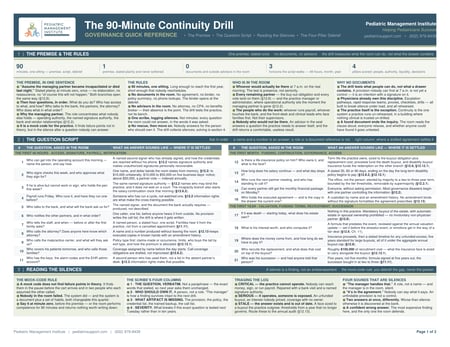
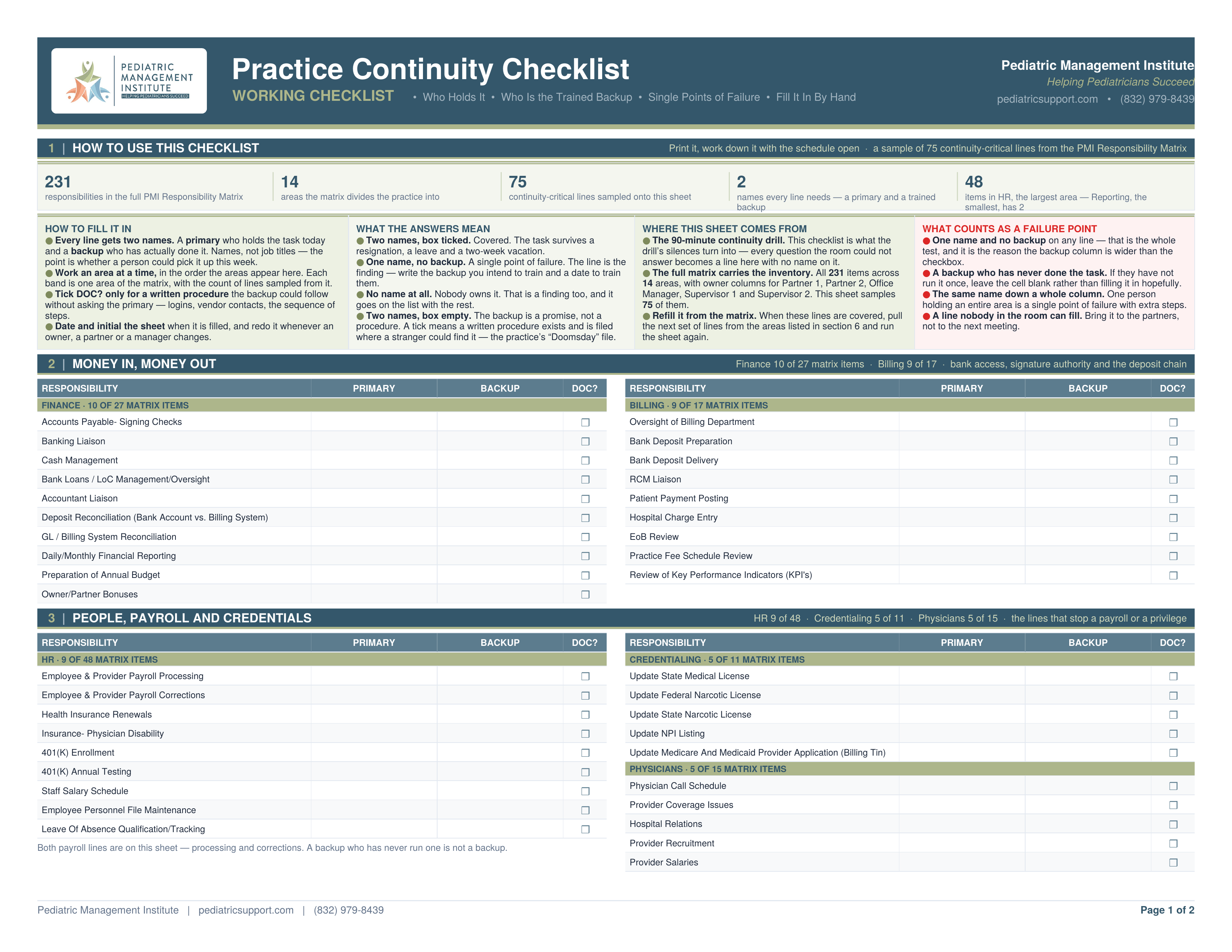
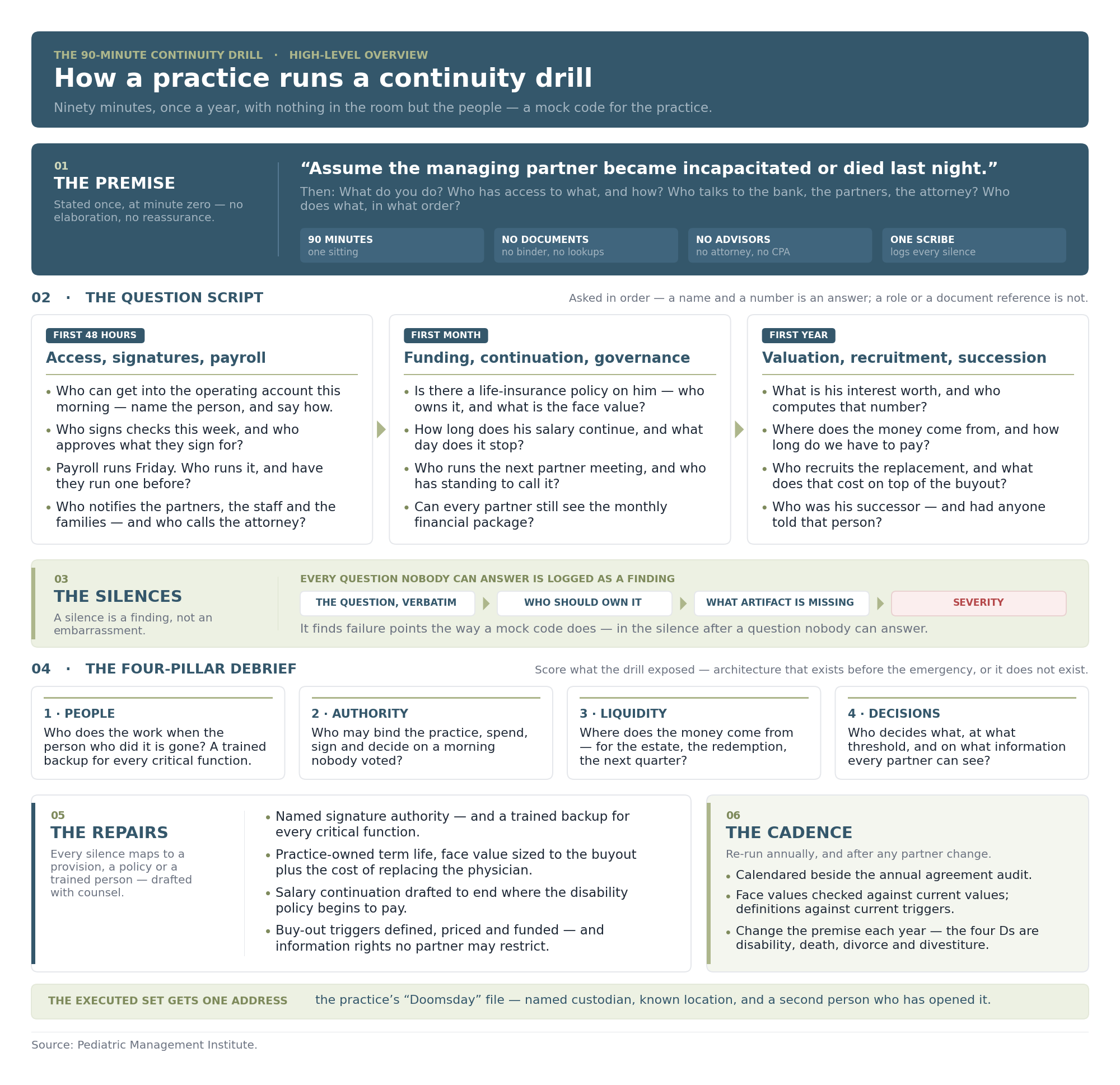
Ninety minutes. No documents and no advisors. Gather whoever would be in the room and open with a single premise, stated plainly. Assume the managing partner became incapacitated or died last night. What happens next? Who has access to what, and how? Who talks to the bank, the partners, the attorney? Who does what in what order?
The questions that follow are not exotic. They are the ordinary business of a Tuesday, asked on the one morning nobody prepared for:
- Who signs the checks?
- Does payroll clear Friday — and who releases it?
- Who calls the attorney, and which attorney?
- Who calls the malpractice carrier, and what is that call for?
- Where is the life-insurance policy, who owns it, and what is its face value?
- How many days must an absence run before the agreement calls it a disability — and whose salary continues in the meantime?
- Which partner can open the practice's own financial reports without asking permission from anyone?
- Who covers tomorrow's call schedule, and who tells the families?
- Can anyone left in the room lawfully bind the practice to a contract by the end of the week?
The rules are the whole design:
- No documents — because the emergency does not wait while somebody finds the binder, and a provision nobody in the room can recall is a provision that will not work at the speed the morning demands.
- No advisors — because the attorney and the accountant are the second call and not the first, and the exercise is measuring what the practice already carries rather than what it can buy.
- Ninety minutes — because a drill is meant to be run, not scheduled and admired.
It will also find the practice's failure points the way a mock code finds them. Not in theory. In the silence after a question nobody can answer. Pediatricians have spent whole careers building the systems that break that silence. Escalation pathways. Rapid response teams. Proxies. Checklists. Drills. The discipline is already in the building. It has simply never been pointed at the practice itself.
The silences are the findings. Write each one down in the words it was asked, because every one of them traces to a decision the partnership agreement either answered or left to improvisation — and a complete pediatric partnership agreement resolves two hundred of those decisions.
Why the silence happens
In most practices, the person holding everything together is the system. Not by anyone's decision, and rarely by anyone's ambition. The managing partner knows the banker because she opened the account. She is the second signature because she has always been the second signature. She reads the monthly financial package because nobody else asked for it. None of that is written anywhere, and none of it survives her.
The corrective begins with the design of the role, which carries four elements:
- Elected. By majority vote, to a two-to-three-year term with reelection.
- Compensated explicitly. A stipend or protected administrative time, so the work is a defined job rather than an accumulating resentment.
- Bounded. Her authority limited by the agreement's stated dollar thresholds.
- Removable. By a supermajority of the other partners, with full clinical partnership untouched — a provision that exists precisely because it cannot be drafted once it is needed.
A role with four written elements is a role a successor can inherit. A role that is only a person is not.
Three habits sit beneath the thresholds and matter more than the thresholds themselves:
- Named signature authority. The agreement says who may bind the practice, with unauthorized signatures made personally recoverable, because vendors do not read bylaws.
- Absolute information rights. Every partner is entitled to the monthly financial package, and no partner's access to the books, the bank statements, or the practice-management system may be restricted — most governance disasters begin with one partner controlling the information.
- Annual indexing. The thresholds are indexed or revisited annually, so that numbers set in 2015 are not still governing in 2030.
Those three habits are also, not coincidentally, the answer to three of the drill's sharpest questions. A practice that has named its signatories, published its financials to every owner, and revisited its numbers this year will get through the first half hour without a pause. A practice that has done none of them will spend ninety minutes discovering that its continuity plan was a person's memory.
Architecture is what exists before the emergency
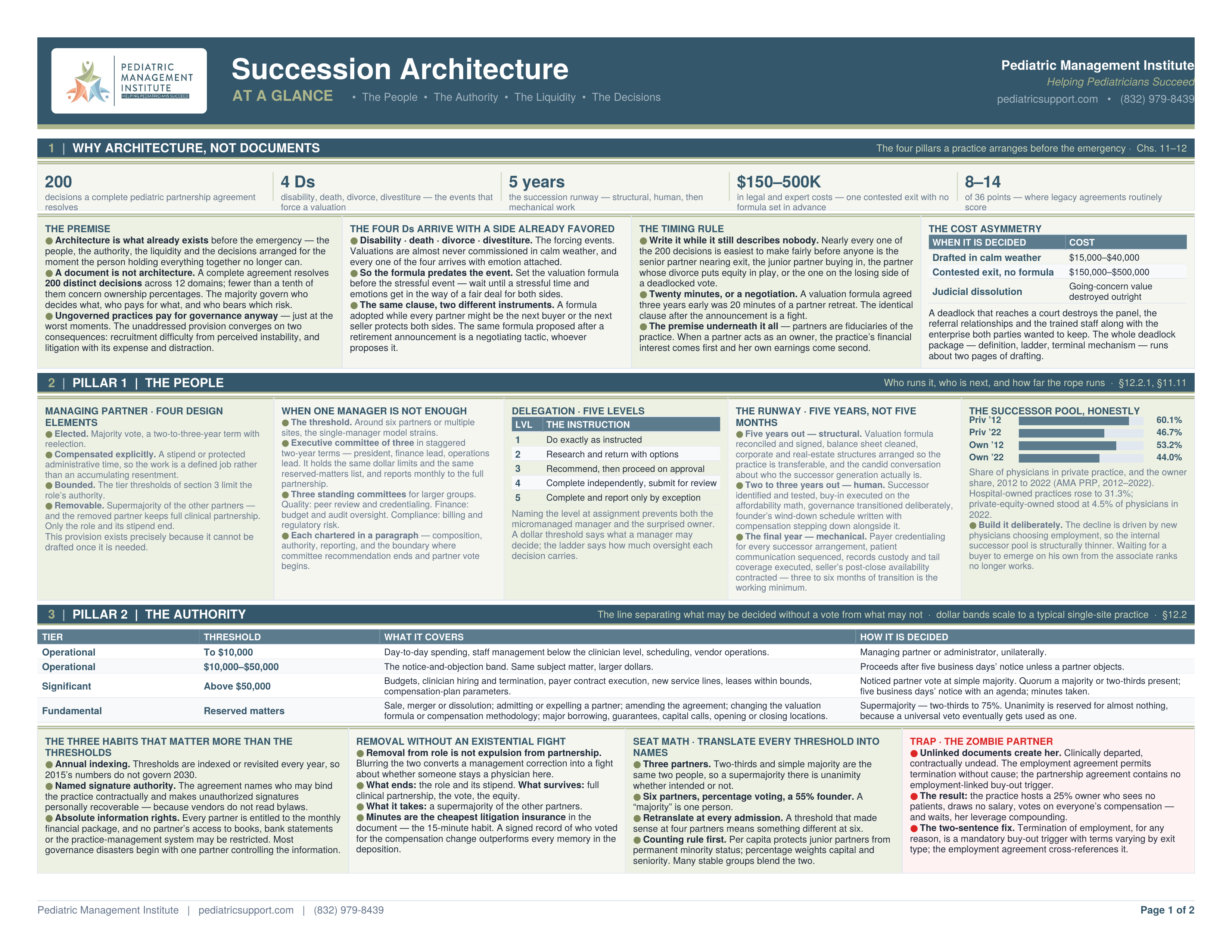
Architecture is what exists before the emergency. Not documents in a drawer, but the people, the authority, the liquidity, and the decisions already arranged for the moment the person holding everything together can no longer do so.
The people come first, and they are structural rather than heroic. Somewhere around six partners or multiple sites, the single-manager model strains and the executive committee succeeds it — three partners in staggered two-year terms, a president, a finance lead, and an operations lead, holding the same dollar limits and the same reserved-matters list and reporting monthly to the full partnership. Beneath the committee runs the five-level delegation ladder that turns "handle it" into an instruction:
- Do exactly as instructed.
- Research and return with options.
- Recommend, then proceed on approval.
- Complete independently and submit for review.
- Complete and report only by exception.
Naming the level at assignment prevents both the micromanaged manager and the surprised owner. Above all of it sits the runway, and the textbook's phrase for its length is the one worth repeating in the drill: five years, not five months. The structural work happens five years out, the human work of identifying and testing a successor at two to three years, the mechanical work of credentialing and patient communication in the final year.
Then the authority, which the drill tests more brutally than any other arrangement, because the question is never only who was in charge. It is what the survivors may decide without her. Three tiers answer it:
- Operational. Spending runs to $10,000 unilaterally, and from $10,000 to $50,000 on five business days' notice and objection.
- Significant. Decisions above $50,000 take a noticed simple-majority partner vote.
- Fundamental. Sale, merger, dissolution, admitting or expelling a partner, amending the agreement, changing the valuation formula — a two-thirds to 75 percent supermajority.
Each threshold gets translated into names before adoption and retranslated at every admission, because a threshold that made sense at four partners means something different at six.
The money, and the decisions already made
Liquidity is the arrangement the drill exposes fastest, because it is the only question in the room with a number attached to it. Practice-owned term life insurance on each partner funds the death trigger, and the face value is sized to the buyout obligation plus the cost of replacing the physician, never the buyout alone. A $400,000 buyout obligation plus roughly $150,000 of recruitment cost argues for $500,000 to $600,000 per partner, because the practice that loses a partner owes the estate and must recruit at the same time. The policy is five- or 10-year term rather than whole life, since the practice is funding a contingency and not building an asset, and it is re-shopped at renewal against the then-current buyout value. And the practice pays the premium without deducting it: the non-deductible premium is what keeps the death proceeds non-taxable, with the CPA confirming the treatment, because a deducted premium discovered at claim time is a tax problem arriving in the worst week of the partnership's life.
Disability is the same architecture aimed at a partner who survives. Mandatory individual coverage is a condition of partnership, and disability buyout insurance funds the redemption, so the practice never has to choose between its cash reserves and its disabled partner. Where partners draw a guaranteed base, the agreement can continue that base for a stated 30, 60, or 90 days, with a coordination clause ending the continuation on the day the long-term policy begins to pay. Agreement, insurance, and calendar drafted as one instrument — and no awkward conversation about money while a partner recovers.
The decisions come last on the list and cost the least to make. Six events end a partnership interest — death, disability, divorce, retirement, voluntary departure, and for-cause termination — and each one gets four things in writing: a definition, a valuation treatment, a payout structure, and a funding source. Defined, priced, funded, and, where a spouse or an estate could otherwise inherit a vote, protected. The valuation field organizes the forcing events into the four Ds — death, disability, divorce, and divestiture — and attaches a single timing rule to all of them: the formula is set before the stressful event, because emotions get in the way of a fair deal once the event has arrived. Two checks keep the whole apparatus current, and both belong on the annual audit. Insurance face values are checked against current buyout values. Trigger definitions are checked against current triggers. A face value sized to a stale valuation is not funding; it is a rounding error with a policy number.
Putting the drill on the calendar
The drill is not a substitute for the audit; it is the audit's field test. The annual agreement audit takes two hours once a year and walks eight steps:
- Re-run the scorecard.
- Re-sign the valuation.
- Reconcile the year's hires, departures, and leases against the provisions they tested.
- Check the definitions across every employment contract.
- Verify the insurance face values and guarantee releases.
- Index the thresholds.
- Log the amendments.
- Close on the question that keeps the exercise honest: which provision would embarrass the partners if tomorrow's event tested it?
The continuity drill is that last question asked out loud, in front of the people who would have to answer it, with the answers timed.
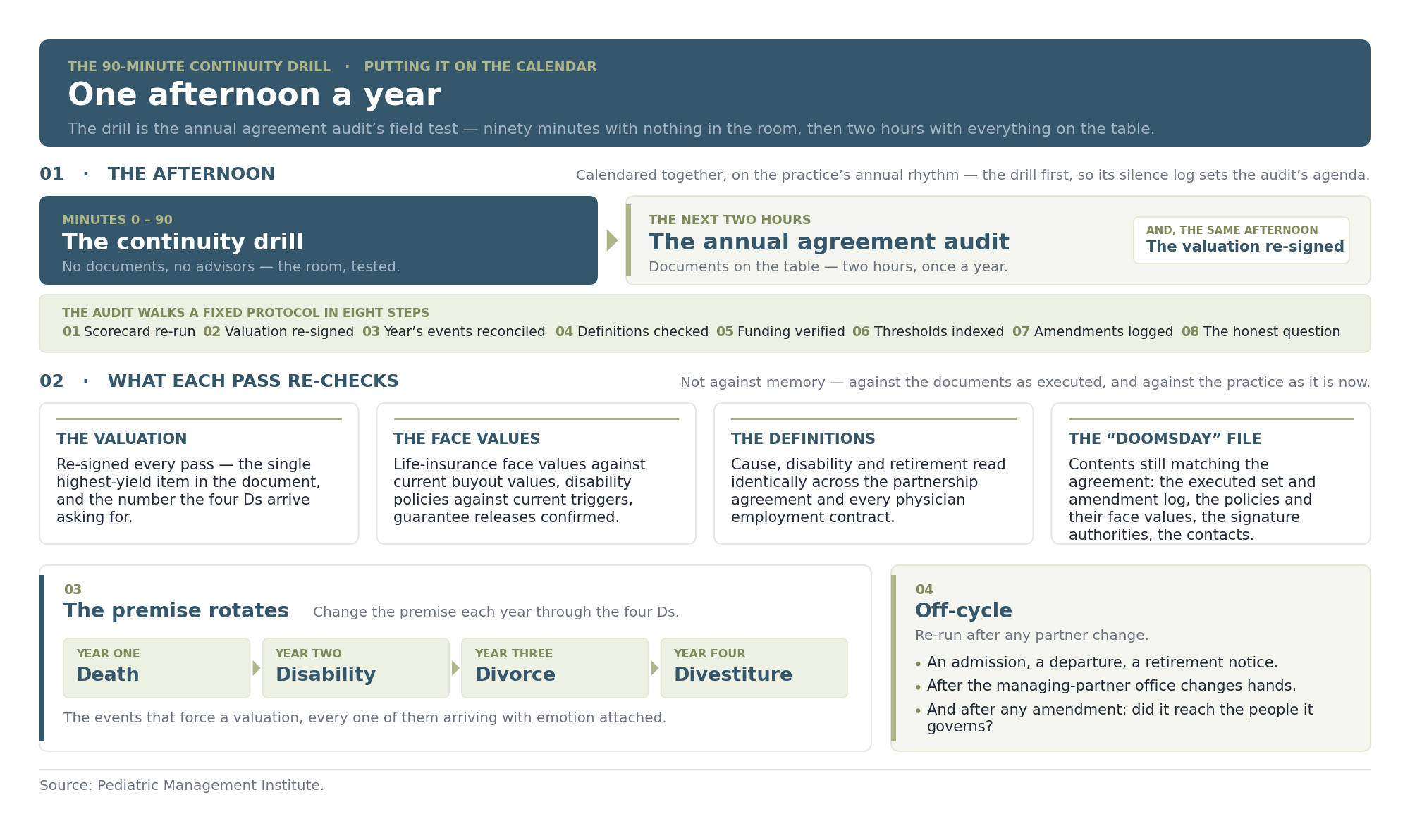
The drill's findings deserve one more artifact. Every repaired silence produces a document, and the documents belong in one deliberately arranged place — a "Doomsday" file:
- The current agreement and its amendment log.
- The insurance policies, with their face values and carrier contacts.
- The named signature authorities, and the banking officer who knows them.
- The salary-continuation terms.
- The attorney's and the CPA's direct lines.
- The authority for tomorrow's call schedule.
The name is theatrical on purpose; a file with a dull name is a file nobody keeps current. And the protocol around the file matters as much as the folder: a named custodian, a known location, a second person who has opened it, and a standing line on the annual audit confirming the contents still match the agreement they summarize. The drill's no-documents rule has a corollary the file completes. The room should know the answers without the binder — and the binder should exist anyway, because memory is architecture only while the room is intact.
The arithmetic that justifies the ninety minutes is the same arithmetic that justifies the two hours. Drafting a thorough agreement while the partners still get along runs $15,000 to $40,000 in legal fees. A single contested exit without a valuation formula routinely burns $150,000 to $500,000 in combined legal and expert costs. And the clock in a real continuity failure runs faster than owners assume: even half a day of closed doors starts patients scattering, and a practice that stays dark for two weeks while an estate attorney works out who is in charge has lost much of what its owners were counting on selling.
So run it. Book the ninety minutes, name the premise, and let the room find out what it does not know. What the mock code is to the resuscitation, the drill is to the succession — nobody schedules one because the emergency is expected this week. They schedule one because the silence is cheaper to find on an ordinary afternoon than on the worst morning of the practice's life.
Red flags a continuity drill will surface
- Nobody can name a second signatory on the practice's bank accounts, or say whether the agreement names one at all.
- Payroll release depends on one person's credentials, and no one else knows whether Friday clears.
- The face value of the practice's life insurance on each partner is unknown in the room — or known, and smaller than the buyout obligation plus recruitment cost.
- The premium is being deducted, putting the non-taxable treatment of the death proceeds in question.
- At least one partner cannot open the practice's own financial reports without asking someone's permission.
- The valuation behind the buyout number has not been re-run and re-signed this year.
- Disability is undefined in days, or defined differently in the partnership agreement than in the employment contracts and the policy.
- No successor to the managing partner is named, and the role has no written term, stipend, bound, or removal mechanic.
- Tomorrow's call schedule has no owner other than the person the drill just removed from the room.
- No "Doomsday" file exists — no named location holding the agreement, the policies, and the contacts, no custodian, and no annual check that its contents still match the documents they summarize.
Frequently asked questions
What is a continuity drill for a medical practice?
A ninety-minute tabletop exercise run on one premise — the managing partner became incapacitated or died last night — with no documents and no advisors in the room. The partners and the practice manager work through the questions the next morning would actually ask: signature authority, payroll, the bank, the attorney, the malpractice carrier, the life-insurance face value, access to the financial reports, and tomorrow's call schedule. The questions nobody can answer are the output, and each maps to a provision the partnership agreement either resolved or left to improvisation.
How much life insurance should a practice carry on each partner?
Enough to fund the buyout obligation plus the cost of replacing the physician, because a practice that loses a partner owes the estate and must recruit at the same time. On a $400,000 buyout obligation with roughly $150,000 of recruitment cost, that argues for $500,000 to $600,000 of practice-owned coverage per partner, written as five- or 10-year term rather than whole life and re-shopped at renewal against the then-current buyout value. The premium is paid without being deducted, which is what keeps the proceeds non-taxable.
How far ahead should you plan a practice succession?
Five years, not five months. The structural work — reconciling the valuation formula, cleaning the balance sheet, separating the real estate, and deciding candidly who the successor generation actually is — belongs five years out. Identifying and testing the successor, executing the buy-in, and transitioning governance belong at two to three years. Credentialing and patient communication are the final year's work. A shorter runway does not compress the tasks; it forfeits them.
What belongs in a practice's "Doomsday" file?
One named location with one named custodian, checked at the annual agreement audit: the current partnership agreement with its amendment log, the practice-owned life and disability policies with face values and carrier contacts, the named signature authorities and banking contacts, the salary-continuation terms, the attorney's and CPA's direct lines, and the call-schedule authority. The file is the drill's companion, not its substitute — the drill tests what the room can do without documents, and the file is what the room reaches for once it has proven it can.
Put the agreement to the test
The Partnership Agreement Analyzer scores an existing agreement against the framework this series is built on — or schedule a discovery call to work through it with PMI. The full framework, with the arithmetic, lives in the textbook Pediatric Practice Management: The Fundamentals.