
Retirement is a defined status, commonly set by age or years of service and paired with permanent withdrawal from practice in the market. Notice of 12 to 24 months matches the time recruiting actually takes, a 25 to 50 percent buyout discount gives short notice a price, and a semi-retirement pathway keeps senior physicians contributing on reduced schedules instead of leaving outright.
The senior partner mentions it at the end of a Thursday lunch, in the tone people use for decisions they have made but not yet admitted making. Another year. Maybe two. Nobody writes it down, because writing it down would make it real, and the practice goes back to work. Eighteen months later a letter arrives giving 60 days’ notice, and the group discovers that it needs to recruit a pediatrician, renegotiate a call schedule, fund a buyout, and reassign a panel built across a career, all inside a quarter.
Retirement ought to be the most orderly transition a partnership ever manages. It is the only trigger that announces itself in advance, the only one where the departing partner wants the transition to succeed, and the only one that every partner will eventually use. Yet retirement provisions are routinely missing, vague, or so punishing that they push physicians to resign for other reasons rather than retire under the terms on offer. A practice that makes retiring more expensive than quitting has built exactly the wrong incentive, and it will find out.
Define the status first. Retirement is not an emotion; it is a defined condition with defined consequences, commonly set by age, by years of service, or by both—age 60, or 30 years of practice, is a familiar setting—and paired with a permanent withdrawal from clinical practice within the practice’s market. The definition matters because retirement usually carries the gentlest treatment in the whole agreement: the softest non-solicit tier, the practice-funded tail, sometimes the most favorable payout terms. A partner who can claim retirement status, collect the retirement package, and open an office six miles away has found the seam in a document that never defined the word. Close it by tying the label to the conduct.
Then require notice, and require a lot of it. Twelve to 24 months of advance written notice is the working band, and the rationale is recruiting arithmetic rather than ceremony. Replacing a physician’s productivity takes a full hiring cycle plus credentialing, and credentialing alone can consume a season. Notice is what lets the practice find the right candidate rather than the available one, and it is what lets a retiring physician hand over a panel instead of abandoning it.
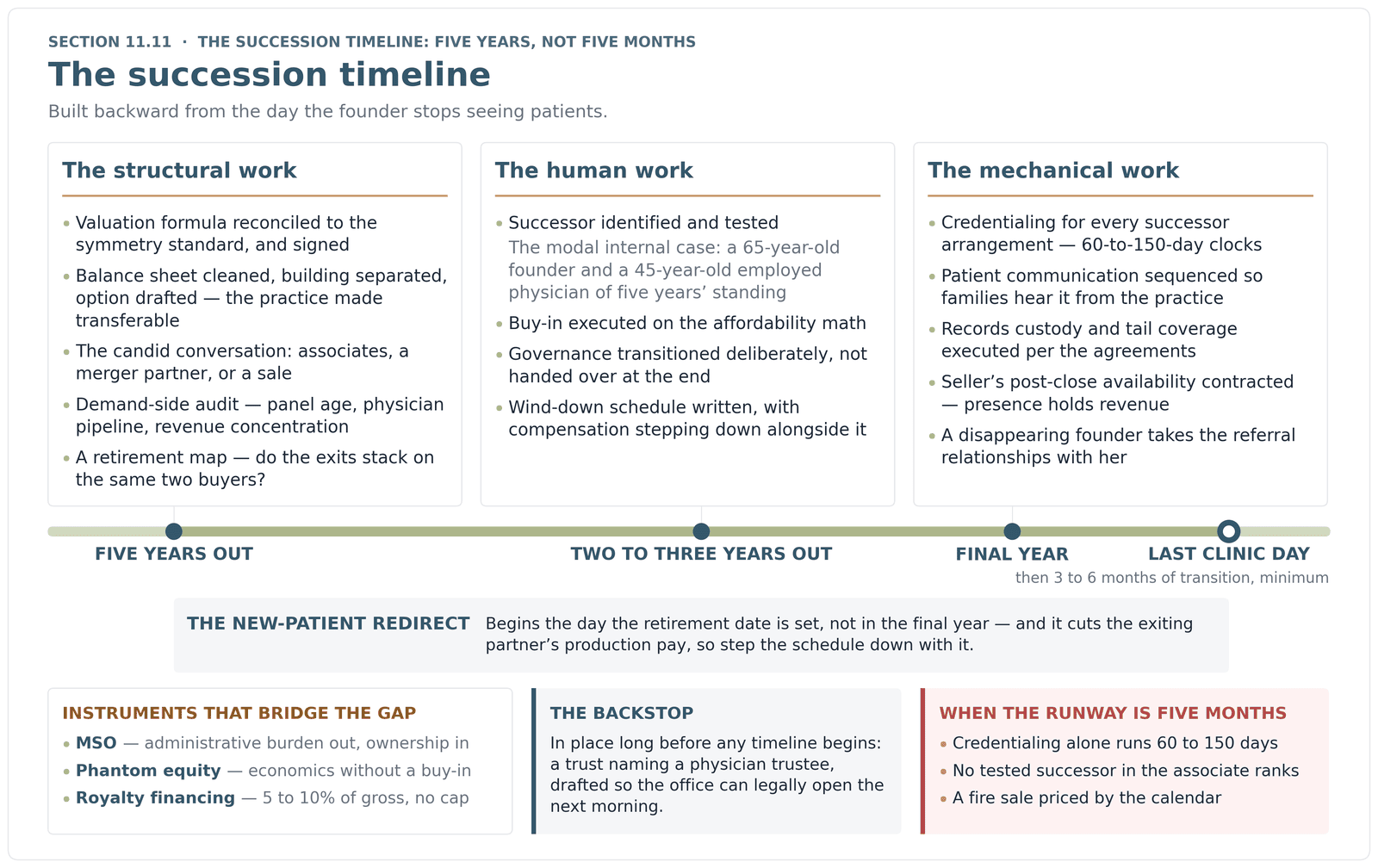
Give the requirement teeth, and price the teeth in the open. The short-notice discount—the failure-to-plan provision—reduces the buyout when the practice is denied transition time. A working schedule discounts the buyout 25 percent for less than a year’s notice and 50 percent for less than six months; other groups draft it as a graduated reduction, a stated percentage for each year of notice not given. Either structure works. What matters is that the number is real and that its rationale is stated in the document, because the discount is not punishment. A partner who denies the practice its recruiting runway has shifted a genuine cost onto the colleagues who remain, and the discount prices it. Check the provision against the document rather than assuming it: plenty of agreements contain a notice requirement and no consequence, which is a request rather than a rule.
Semi-retirement is where most of the value hides, and most agreements have nothing to say about it. The partner at 62 who wants four days, then three, then two clinic days and no call is frequently the most valuable asset the practice has—a physician whose panel is loyal, whose referral relationships are intact, and who is prepared to mentor the associate the practice is about to recruit. Given a pathway, that physician stays five more years. Denied one, that physician retires all at once, or takes a part-time hospital position that comes with a covenant fight. Draft the pathway: FTE thresholds that define each step, compensation adjusted on published rules rather than negotiated each time, call and weekend obligations stated, and the equity question answered—whether a reduced-schedule partner keeps full equity, converts to a non-voting class, or begins a scheduled redemption.
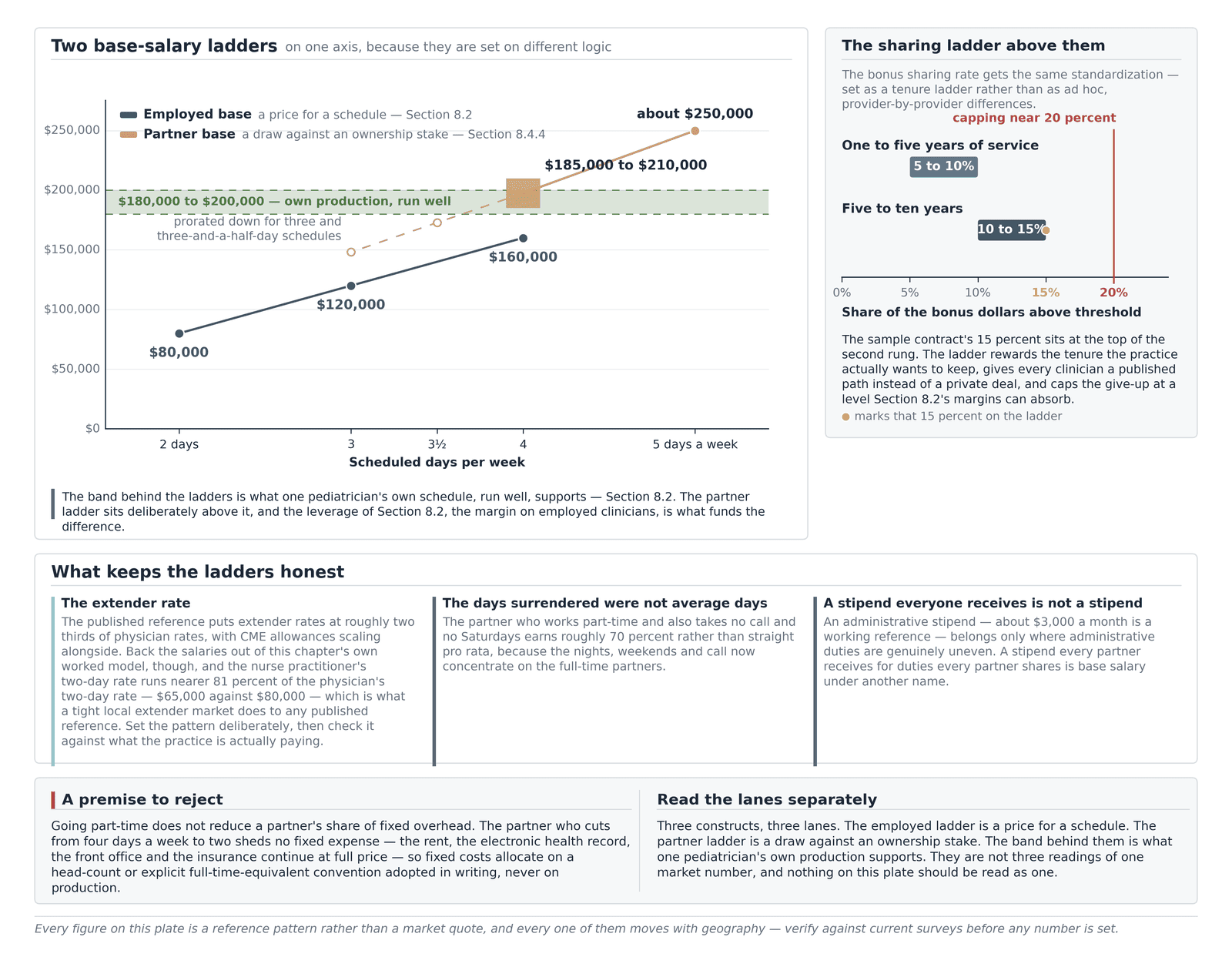
Two asymmetries keep that proration honest. A partner who sheds call and Saturdays along with clinic days has shed the least pleasant work as well as the volume, and compensation nearer 70 percent of full rather than straight pro rata reflects it. And an administrative stipend belongs only where the administrative duties are actually uneven. On the governance side, the common resolution is full votes on fundamental matters and FTE-weighted votes on operating ones, decided before anyone is on a reduced schedule rather than after.
Compensation during the wind-down follows the same discipline: published, not negotiated. So does the buyout formula, which should be the same formula every other trigger uses, run against a valuation the partners re-sign annually. A retirement buyout priced off a book value nobody has refreshed since the practice had one location is a dispute with a date on it. The deeper valuation mechanics—which standard of value applies, how the ownership premium is computed, how a successor finances the purchase—are worked in full in the companion textbook, Pediatric Practice Management: The Fundamentals.
The cost of skipping all of this shows up as a story. Two rural pediatricians, 11 years in, held a nine-page agreement whose governance section read, in its entirety, “decisions shall require mutual consent.” When a hospital system made an offer, Davis, 61, with a spouse ready to travel, wanted to sell. Fontenot, 48, wanted to build toward an internal succession. The agreement had no retirement pathway, no deadlock machinery, and no valuation formula, so an ordinary difference in timing became 14 months of paralysis: an office manager unhired for five months, an electronic records contract renewed by default, two of nine staff resigned, collections down nine percent, and the acquisition offer lapsed. The eventual resolution was the mechanism the agreement should have carried all along—an appraisal-based buyout, a five-year note, and a retirement-tier non-solicit. The professional fees ran a little over $140,000, and the lost collections roughly $95,000 more.
Red flags. Retirement undefined, so the status can be claimed strategically. No notice requirement, or notice with no consequence attached. No semi-retirement pathway, forcing an all-or-nothing choice on physicians in their most valuable decade. A buyout formula disconnected from any current valuation. And retirement timing that has never appeared on a partners’ meeting agenda, in a group whose senior partner is well into his sixties.
The most orderly retirements are the ones planned while nobody was ready to leave. Put the question on the calendar every year, and it is a conversation. Wait for the letter, and it is a crisis with a countdown.
Practical steps for a retirement provision
- Define retirement by age, years of service, or both, tied to permanent withdrawal from practice in the practice’s market.
- Require 12 to 24 months of advance written notice.
- Attach a consequence: a stated short-notice discount, with its recruiting rationale written into the document.
- Draft a semi-retirement pathway with FTE thresholds, published compensation rules, and call obligations stated.
- Answer the equity question for reduced-schedule partners: full equity, a non-voting class, or a scheduled redemption.
- Use the same buyout formula every other trigger uses, run against a valuation the partners re-sign annually.
- Put retirement timing on a partners’ meeting agenda every year.
Frequently asked questions
How much notice should a retiring physician partner give?
Twelve to 24 months is the working band, and the rationale is recruiting arithmetic rather than ceremony. Replacing a physician’s productivity takes a full hiring cycle plus credentialing, and credentialing alone can consume a season. Notice is what lets the practice find the right candidate rather than the available one, and what lets a retiring physician hand over a panel instead of abandoning it.
What is a short-notice discount?
It is the failure-to-plan provision that reduces the buyout when the practice is denied transition time. A working schedule discounts the buyout 25 percent for less than a year’s notice and 50 percent for less than six months, while other groups draft a graduated reduction for each year of notice not given. The discount is not punishment; it prices a cost shifted onto the colleagues who remain.
How does semi-retirement work for a partner?
A drafted pathway states the FTE thresholds that define each step, compensation adjusted on published rules rather than negotiated each time, call and weekend obligations, and the equity answer, whether a reduced-schedule partner keeps full equity, converts to a non-voting class, or begins a scheduled redemption. A partner who sheds call and Saturdays as well as clinic days sits nearer 70 percent of full rather than straight pro rata.
Put the agreement to the test
The Partnership Agreement Analyzer scores an existing agreement against the framework this series is built on — or schedule a discovery call to work through it with PMI. The full framework, with the arithmetic, lives in the textbook Pediatric Practice Management: The Fundamentals.