
The 12-dimension scorecard turns an agreement's condition into a number: each dimension scored 0 to 3 against what the practice actually does, for a total out of 36. The as-executed rule scores what the practice actually does rather than what it wrote, the maintenance dimension is read first because it predicts how fast the others decay, and the deliverable is the ranked repair list rather than the total.
The agreement sits in a drawer, or in a shared folder nobody browses. It was signed years ago by partners who were relieved to be finished with it. Since then the practice has hired, moved, refinanced, and admitted a partner. Ask the group today whether the document still holds, and what comes back is opinion. The senior partner believes it is fine. The newest partner has never read it. The practice manager knows where the signed copy lives but not what it says. Opinion is what a practice carries when it has never measured. A scorecard replaces the opinions with a number, and a number can be ranked, argued with, and trended.
The instrument PMI uses in governance engagements has 12 dimensions, each scored zero to three. That puts 36 points on the table. The scale is short. Zero: the subject is missing. One: it is addressed vaguely. Two: it is drafted, but stale or asymmetric. Three: it is complete, current, and consistent with the practice’s other documents. Most legacy agreements score in the low teens or below.
One rule governs the whole exercise, and it is the rule that keeps the number honest: score the documents as executed. Not the draft counsel circulated last spring. Not the term sheet everyone nodded at. Not the amendment the partners agree in principle to make. An unsigned draft scores zero, because on the day a provision is tested, an unsigned draft is worth exactly nothing. A scorecard run against intentions measures intentions.
The 12 dimensions, with what earns a three on each:
- Ownership and equity structure. Percentages, classes, full-time-equivalent thresholds, and advanced practice provider eligibility all explicit.
- Valuation and buy-in. Symmetric methodology, four variables answered, an annual signed update.
- Governance tiers and voting. Three tiers with thresholds, seat math tested, quorum, notice, and minutes.
- Managing partner and authority. Election, term, removal, binding authority, and information rights.
- Compensation and distributions. Formula documented, reserves defined, a distribution governor.
- Capital and debt. Call mechanics with consequences, caps, debt authority, guarantee allocation.
- Life-event triggers. Death, disability, divorce, and retirement each defined, priced, and funded.
- Exit and expulsion. Notice, transition gates, automatic triggers, bad-leaver terms, payout caps.
- Covenants, intellectual property, and brand. Enforceable-by-design covenants, tiered non-solicits, IP and name owned.
- Deadlock and disputes. Ladder drafted, terminal mechanism chosen, arbitration with carve-outs.
- Pediatric operations. Vaccine liability and reserves, VFC responsibility, after-hours costs, portal credit.
- Maintenance and consistency. Annual audit calendared, amendment log, two-document consistency, custody.
Read those as standards, not as topics. Dimension 4 is not satisfied by naming a managing partner; it wants election, term, removal, the limits of that partner’s binding authority, and the information rights every other partner holds against the office. Dimension 2 is not satisfied by a valuation clause; it wants a methodology that reads the same coming in as going out, and a number re-signed every year. Vagueness is a one. Only completeness, currency, and consistency earn a three.
Dimension 12 is the one groups score last and should score first. Maintenance and consistency do not describe what the agreement says. It predicts how fast everything else stops being true: the annual audit on the calendar, the amendment log, the consistency rules between the partnership agreement and every employment contract, and custody of the executed copies. A practice scoring three there holds its other scores. A practice scoring zero there is watching all 11 remaining dimensions decay, whatever they measured on signing day. That is why the scorecard treats it as the meta-dimension.
Calibration works best against a live document, and the Fontenot–Davis agreement serves. Two pediatricians, 11 years together in a rural county, practicing under nine pages drafted in 1998 whose entire governance section read: “decisions shall require mutual consent.” Score it. Ownership and equity structure, one—percentages stated, nothing else. Valuation and buy-in, one: book value, asymmetry unexamined, no update mechanism. Tiers and voting, one: mutual consent, no tiers, no quorum rules. Managing partner, zero; the document is silent. Compensation and distributions, two: a formula documented in an exhibit, reserves unaddressed. Capital and debt, zero. Life-event triggers, one: death addressed through a reference to a lapsed insurance policy, disability and divorce silent.
The back half runs the same way. Exit and expulsion, one: a for-cause list, no automatic triggers, no payout mechanics. Covenants and intellectual property, two: a non-compete of doubtful current enforceability, no non-solicit tiers, no IP provisions—and the two rather than a one rests on the covenant alone, drafted and enforceable when written and merely stale now, while the missing non-solicit tiers and IP provisions cost the third point. Deadlock and disputes, zero, which became the $140,000 dimension the year the partners stopped agreeing. Pediatric operations, zero. Maintenance, zero—last amended for an address. Total: nine of 36.
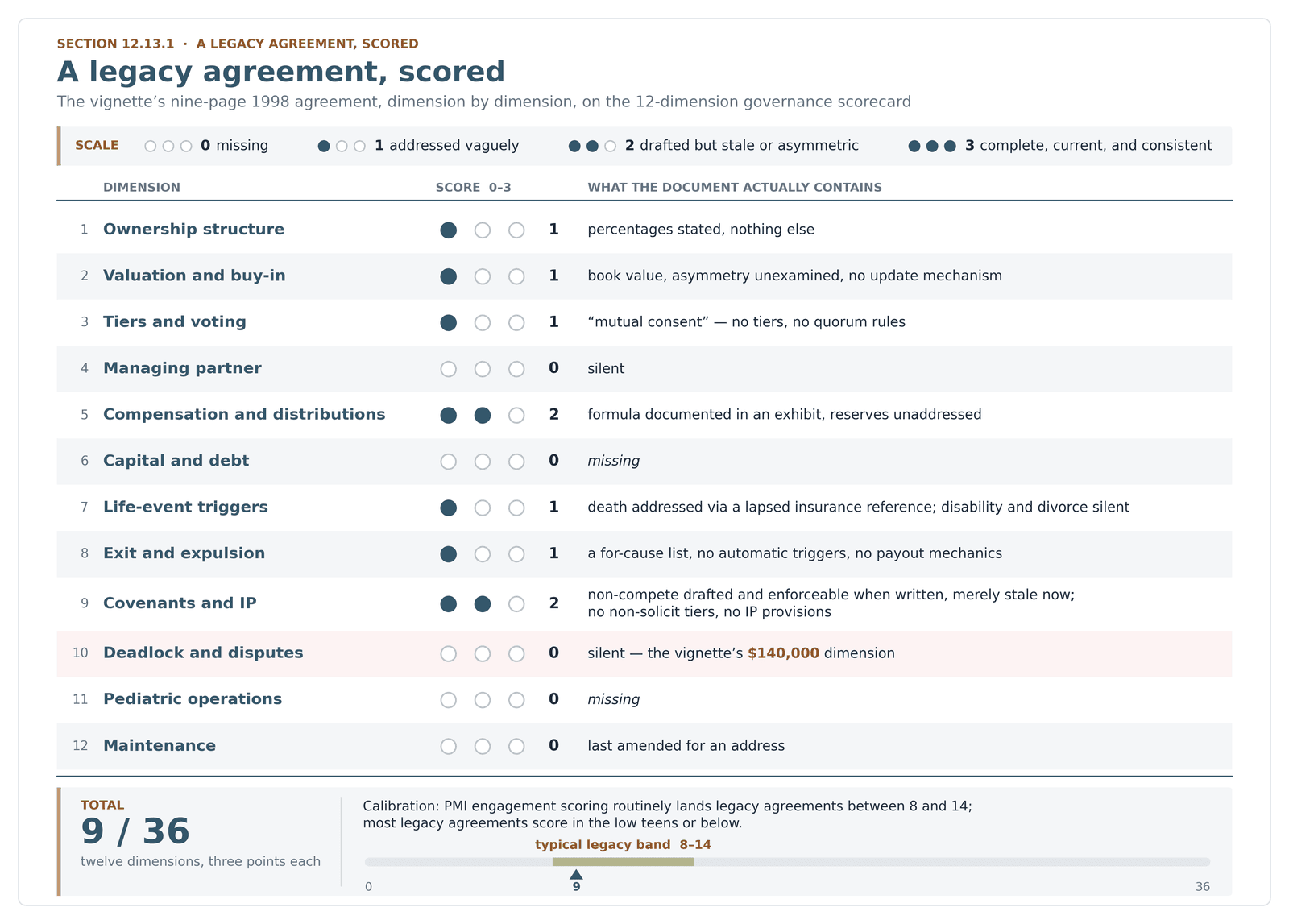
Nine is not an outlier. PMI’s engagement scoring routinely lands legacy agreements between 8 and 14, and this one arrived at nine after 28 years of a practice changing around a document that did not. What the pass produces matters more than what it totals: a ranked repair list. The practice’s own circumstances set the order. Two partners and no deadlock machinery? Dimension 10 first, whatever else is on the list. An aging founder and unpriced life-event triggers? Dimension 7. Rank by cost asymmetry—which gap is most expensive if it is tested first—and the list writes itself.
A score taken once is a photograph. Dimension 12 turns it into a trend line, and the annual agreement audit is dimension 12 put into practice: one meeting a year, calendared with the practice’s annual financial rhythm, walking a fixed protocol. The first step is to re-run the 12-dimension scorecard and trend it against the prior year’s scores. The rest follows. Re-sign the annual valuation, the single highest-yield item in the document. Reconcile the agreement against the year’s events, since every new hire, departure, lease, loan, and location tested some provision. Check the two-document consistency rules, so that cause, disability, and retirement read identically in the partnership agreement and in every physician employment contract. Verify the funding instruments—insurance faces against current buyout values, disability policies against current triggers, guarantee releases for departed partners. Review the dollar thresholds against inflation and re-run the seat math against the current roster. Log amendments with dates and custody. Then close on the question that keeps the exercise honest: which provision would embarrass the partners if tomorrow’s event tested it? The full protocol runs as a 10-point annual review checklist.
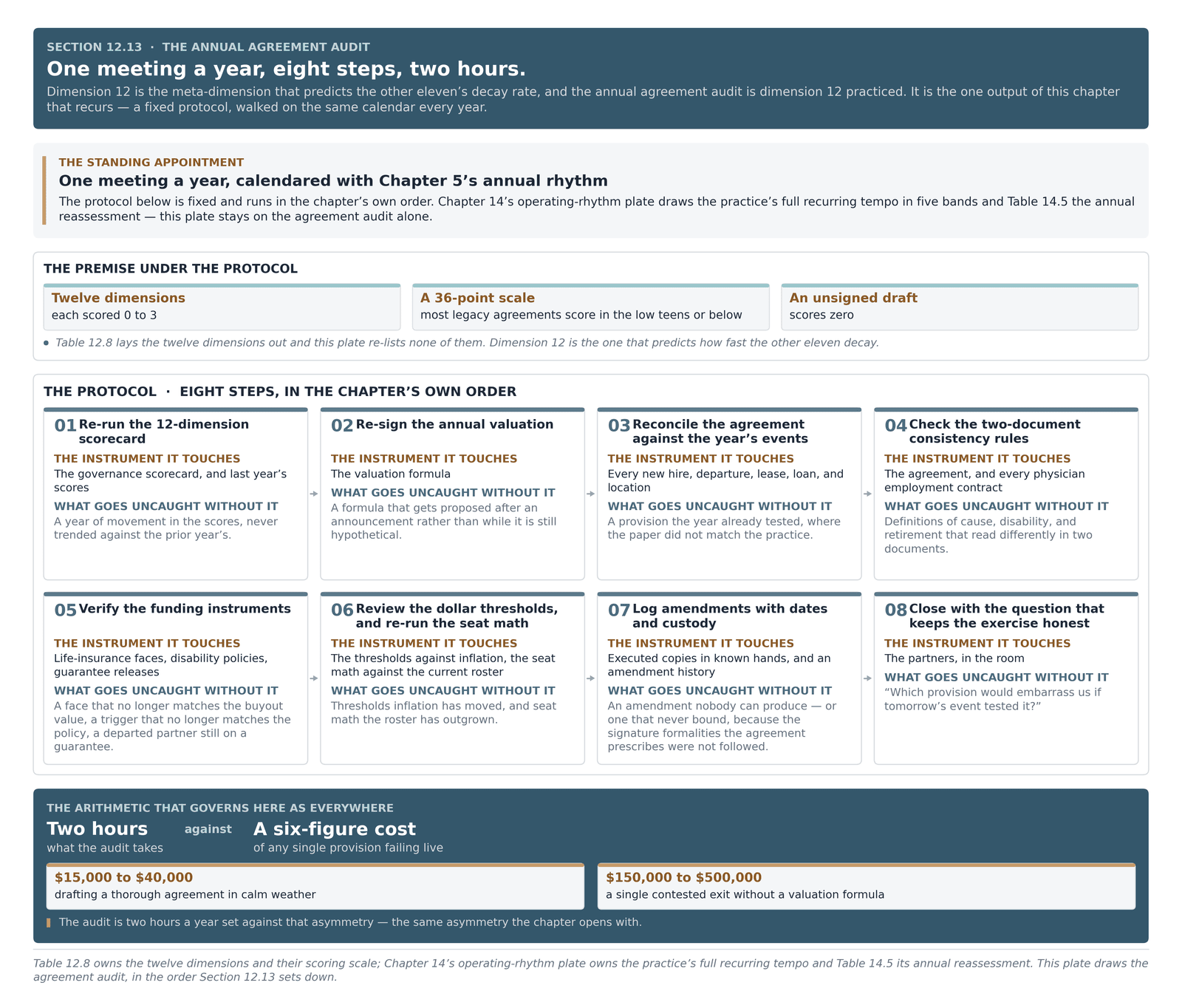
The audit takes two hours. The arithmetic governs here as everywhere: two hours a year against the six-figure cost of any single provision failing live. A second year of scores is worth more than the first: two numbers make a direction. A score that climbed says the repairs landed. A score that has not moved says the amendments everyone discussed never got signed. The Partnership Agreement Analyzer is the scorecard’s self-service cousin: it scores an existing agreement against the framework this series is built on.
Red flags. A score that flatters because it was run against a draft instead of the documents as executed; an unsigned draft scores zero, and a scorecard that forgets it measures intentions rather than obligations. A score nobody trends, taken once, filed, and never set beside a prior year. Dimension 12 scored last as an afterthought instead of first as the predictor of every other dimension’s decay. And a total treated as the deliverable when the ranked repair list is the deliverable, because no practice fixes 12 things at once, and the order is where the money is.
An agreement nobody has scored is not a good one or a bad one. It is an unknown—and unknowns get priced by whichever event arrives first.
Put a number on the agreement
The Partnership Agreement Analyzer scores an existing agreement against the framework this series is built on — or schedule a discovery call to work through it with PMI. The full framework, with the arithmetic, lives in the textbook Pediatric Practice Management: The Fundamentals.
Frequently asked questions
What is the 12-dimension partnership agreement scorecard?
It is the instrument PMI uses in governance engagements: 12 dimensions of a partnership agreement, each scored zero to three, for 36 points in all. Zero means the subject is missing, one means it is addressed vaguely, two means drafted but stale or asymmetric, and three means complete, current, and consistent with the practice's other documents. Most legacy agreements score in the low teens or below.
How do you score a partnership agreement?
Score the documents as executed, dimension by dimension. An unsigned draft scores zero, whatever counsel has circulated, because on the day a provision is tested an unsigned draft is worth nothing. Score dimension 12, maintenance and consistency, first, since it predicts how fast the other eleven decay. Then rank the gaps by which one is most expensive if it is tested first.
What is a good partnership agreement score?
Thirty-six is the maximum, and few documents approach it. PMI's engagement scoring routinely lands legacy agreements between 8 and 14; one nine-page 1998 agreement scored dimension by dimension came to nine of 36. The useful comparison is not another practice but the same practice a year earlier, which is why the annual audit re-runs the score and trends it.