
An annual partnership agreement audit is one two-hour meeting, calendared alongside the practice's annual financial rhythm, that walks the same 10 points every year so the trend is visible. The highest-yield line on the checklist is re-signing the valuation methodology, and findings rank by what each would cost to fail live rather than by ease of repair.
The document is in a drawer, a shared folder nobody browses, or an attorney’s file. It was signed at a moment when everyone was relieved to be finished with it, and nobody has opened it since. Meanwhile the practice hired three clinicians, opened a location, refinanced, admitted a partner, changed carriers, and watched its state legislature rewrite the rules on restrictive covenants. The agreement has not moved. The practice has. Every year that gap widens is a year the document is a little less likely to work on the day it is finally needed.
Two pediatricians in a rural county learned what that costs. They had practiced together for 11 years, collecting about $1.05 million a year with a panel 58 percent Medicaid, under a nine-page agreement whose entire governance section read: “decisions shall require mutual consent.” The sentence worked while they agreed on everything. When a hospital system offered to acquire the practice and one wanted to sell and the other did not, it stopped working—and the deadlock spread downward through every decision the document had never distinguished. An office manager went unhired for five months. An electronic-records contract renewed by default on bad terms. Two of nine staff resigned. Collections fell 9 percent, the offer lapsed, and the professional fees ran a little over $140,000, with roughly $95,000 in lost collections behind them: $235,000 in all, for two pages of drafting neither partner had ever revisited. Scored against a 12-dimension governance standard, their agreement earned nine of 36 available points—which is unremarkable. PMI’s engagement scoring routinely lands legacy agreements between 8 and 14.
The prevention is an annual meeting. One meeting, two hours, calendared alongside the practice’s annual financial rhythm, walking the same 10 points every year so the trend is visible.
- Review every ownership percentage and confirm it still reflects current contributions, current schedules, and the roster as it actually stands, including any part-time or phased arrangements (articles 2 and 13).
- Verify insurance coverage against current values—malpractice limits and carrier standards, life insurance faces measured against today’s buyout obligation plus the cost of replacing the physician, and disability policies checked against the agreement’s own triggers (articles 25, 33, and 34).
- Confirm the compensation formula’s inputs and the overhead allocation methodology, and re-run one partner’s number from the monthly package to prove the formula still computes (articles 5 and 15).
- Review departure and exit provisions against the partners’ current ages and tenure, because a retirement clause drafted for a 45-year-old founder reads differently when she is 58 (articles 36 and 41).
- Verify every restrictive covenant against current state law, since non-compete statutes now change legislative session by legislative session (articles 26 and 27).
- Confirm debt authority, guarantee allocation and release mechanics, and capital call provisions against the practice’s current financial structure and its current lender (articles 11 and 12).
- Review technology and intellectual property provisions against digital assets that did not exist at signing—the portal, the domains, the phone numbers, clinical templates, any dataset, and whatever the practice’s software vendors now touch (articles 28 and 31).
- Verify payer contracting authority and managed care governance, so the question of who may bind the practice to a rate has an answer before the next renewal arrives (article 21).
- Confirm the valuation methodology against current financials, and re-sign the valuation. This is the single highest-yield item in the document, and an unsigned methodology is worth exactly nothing on the day someone dies (article 4).
- Review every provision touched by a legal or regulatory change in the past 12 months, and reconcile the agreement against the year’s own events: each new hire, departure, lease, loan, and location tested some provision, and the audit asks whether the paper matched the practice.
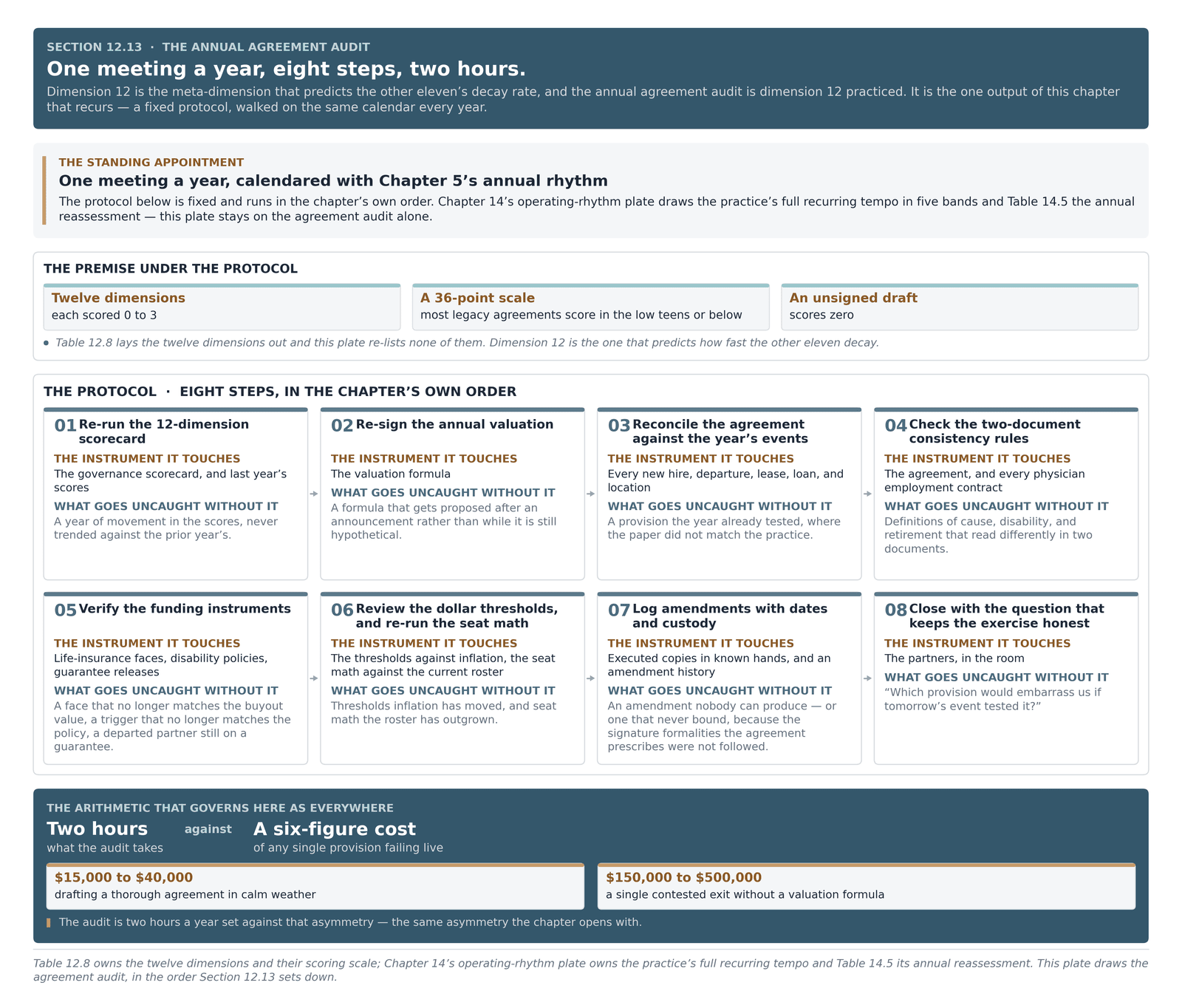
Three habits make the checklist an audit rather than a reading. Check the two-document consistency rules, so that cause, disability, and retirement are defined identically in the partnership agreement and in every physician employment contract—an inconsistency between them is the first thing opposing counsel finds. Log amendments with dates and custody: executed copies in known hands, an amendment history, and the discipline that no amendment binds without the signature formalities the agreement itself prescribes. And close the meeting on the question that keeps the exercise honest: which provision would embarrass the partners if tomorrow’s event tested it?
Some of this work is internal and some is not. The partners and the practice manager can run the scorecard, reconcile the year’s events, re-run the seat math against the current roster, index the dollar thresholds for inflation, check the insurance faces, and maintain the custody log. Counsel handles what counsel must: covenant enforceability after a statute change, entity and tax structure, the drafting and execution of any amendment, and any provision that a regulatory change or a live event actually stressed during the year. The valuation gets signed by whoever the methodology says signs it. The useful division is simple—the audit finds the gaps internally, and the repairs get drafted by someone with a license.
Then rank what the audit found, because no practice fixes 10 things at once. Rank by cost asymmetry: which gap is most expensive if it is tested first. Two equal owners with no deadlock machinery repair that first, whatever else is on the list. A practice with a founder eight years from retirement and unpriced life-event triggers repairs those. Administrative gaps—a stale address, a superseded title, a threshold that inflation has made quaint—go on a list and get swept into the next amendment. That ranking is the whole reason to score the document rather than merely read it.
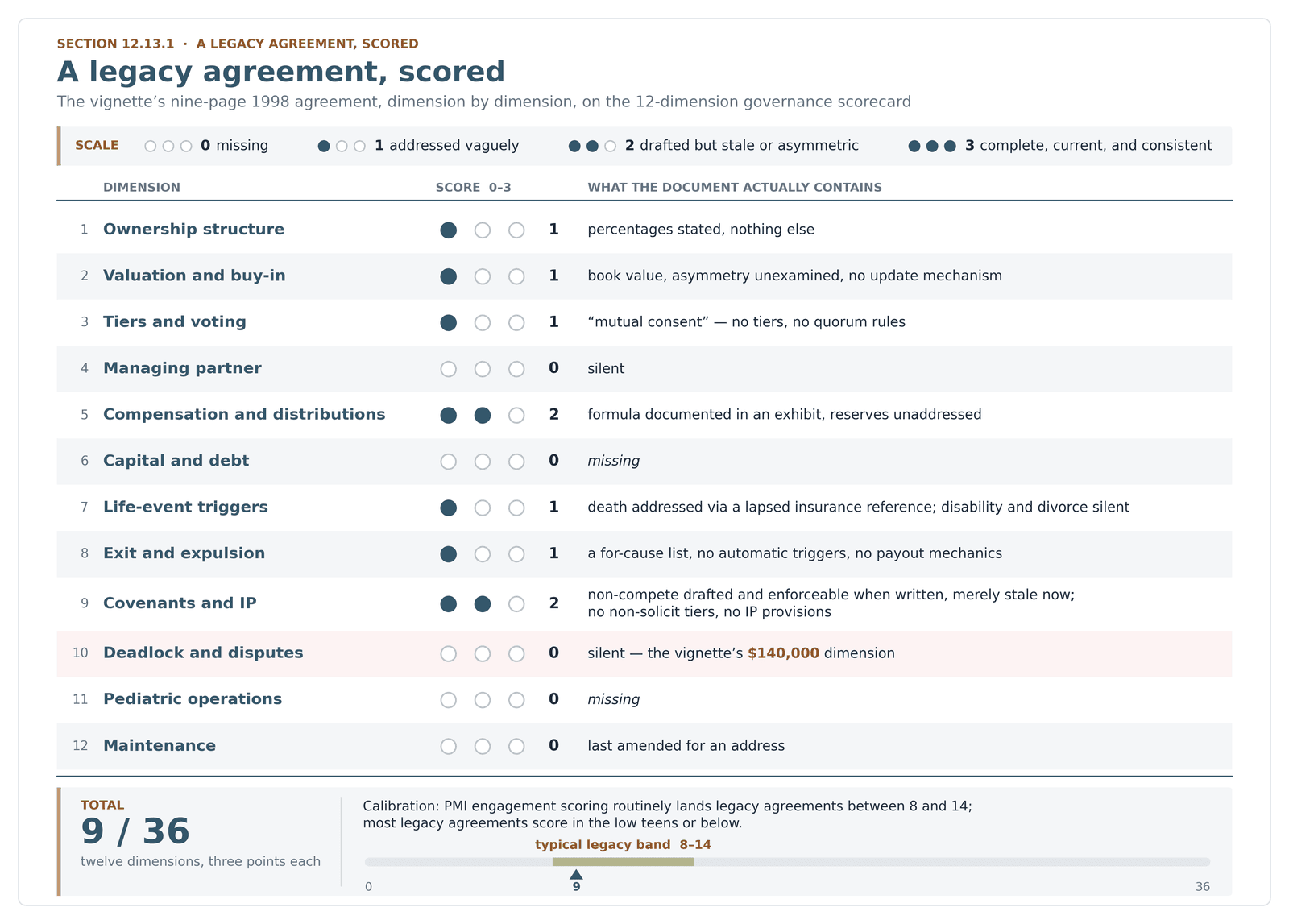
The 50 articles in this series are the raw material for exactly this exercise. The foundations—ownership, buy-in, valuation, compensation, voting, the managing partner, and the two documents every partnership needs—sit in articles 1 through 8. The money runs from articles 9 through 16. Governance and decision-making, including deadlock and the sale question, run from 17 through 24. The protections are articles 25 through 32; the life events, 33 through 40; the exits, 41 through 46. Articles 47 through 49 cover the advanced ground: management services organizations, research and teaching, and the seven provisions a pediatric practice cannot borrow from a template. An agreement that has answered all of it is rare. An agreement that has never been measured against any of it is ordinary, and it is ordinary because measuring was never on anyone’s calendar.
Red flags. An agreement never reviewed since the day it was signed. A non-compete that still cites a state rule three legislative sessions out of date. Life insurance faces unchanged since the original signing, against a buyout obligation that has tripled. A compensation formula referencing a superseded relative value schedule. And retirement provisions that say nothing useful about the partner who is now eight years out.
The rural practice’s story has an ending worth borrowing. When the surviving partner rebuilt the agreement, the annual audit went on the calendar beside the valuation sign-off, and it has stayed there. Two hours a year, against the six-figure cost of any single provision failing live. The companion textbook, Pediatric Practice Management: The Fundamentals, carries the full 12-dimension scorecard the audit trends against.
The most expensive partnership agreement is the one that was signed once and never read again.
The 10-point annual audit, compressed
- Review every ownership percentage against current contributions, schedules, and roster, including any part-time or phased arrangements.
- Verify malpractice limits, life insurance faces against today's buyout obligation, and disability policies against the agreement's own triggers.
- Confirm the compensation formula's inputs and overhead allocation, re-running one partner's number from the monthly package.
- Review departure and retirement provisions against current ages and tenure; verify every restrictive covenant against current state law.
- Confirm debt authority, guarantee allocation and release mechanics, and capital call provisions against the current lender.
- Review technology and intellectual property provisions against new digital assets, and verify payer contracting authority before the next renewal.
- Confirm the valuation methodology against current financials and re-sign it; reconcile the year's legal changes and events.
Frequently asked questions
How often should a partnership agreement be reviewed?
Once a year, in a single two-hour meeting calendared alongside the practice's annual financial rhythm, walking the same 10 points every year so the trend is visible. The gap widens without it: the agreement stays where it was signed while the practice hires clinicians, opens a location, refinances, admits a partner, changes carriers, and watches its legislature rewrite the covenant rules.
What does an outdated partnership agreement cost?
Two pediatricians practicing under a nine-page agreement whose governance section read that decisions shall require mutual consent deadlocked when one wanted to sell to a hospital system and the other did not. An office manager went unhired for five months, two of nine staff resigned, and collections fell 9 percent. Professional fees ran a little over $140,000, with roughly $95,000 in lost collections behind them.
Which part of the annual audit matters most?
Confirming the valuation methodology against current financials and re-signing it. That is the single highest-yield item in the document, because an unsigned methodology is worth exactly nothing on the day someone dies. The audit's findings then get ranked by cost asymmetry, meaning which gap is most expensive if it is tested first, since no practice fixes 10 things at once.
Put the agreement to the test
The Partnership Agreement Analyzer scores an existing agreement against the framework this series is built on — or schedule a discovery call to work through it with PMI. The full framework, with the arithmetic, lives in the textbook Pediatric Practice Management: The Fundamentals.