
An occurrence policy answers incidents from its policy period whenever the claim arrives; a claims-made policy answers only claims reported while it is in force. The difference surfaces at departure as the tail — one and a half to two times the annual premium — and the agreement assigns that cost by exit scenario, which matters longer in pediatrics because a minor's claim can wait until adulthood.
A partner resigned three years ago on good terms, with a card signed by the staff and a dinner at the steakhouse. The letter that arrives this morning is from a plaintiff’s attorney, and the care at issue was delivered while she was still on the schedule. Which policy answers it? Who directs the defense? And if closing the gap requires buying coverage now, at a five-figure premium, who writes that check? In most practices the answer is discovered rather than known—usually at speed, with a former colleague on speakerphone and everyone’s memory of the original conversation drifting in a convenient direction.
Malpractice coverage is where the personal and the professional intersect at their most consequential, and it is also where partnership agreements run thinnest. A document that prices the buy-in to the dollar will frequently say nothing about which kind of policy the practice buys, what limits it carries, or what happens to the reporting gap when a partner walks out the door. PMI has refereed that argument more than once, and it is never settled on the merits—it is settled by whichever side can least afford to keep arguing. Fixing the gap costs an afternoon. Discovering it costs whatever the premium happens to be on the day it is needed.
Start with the two policy structures, because every other decision descends from the choice between them. An occurrence policy responds to incidents that took place during the policy period, whenever the claim is eventually reported—five years later, ten years later, after the policy has lapsed and the carrier has been replaced. A claims-made policy responds only to claims reported while it is in force, and only for incidents on or after the policy’s retroactive date. The second structure is cheaper in the early years and steps up toward maturity over several, which is why it dominates the physician market. It also leaves a hole. A suit filed after a physician’s coverage ends, on care delivered while it was active, lands in a space that neither the expired policy nor the new one answers.
Two instruments close that hole, and an agreement should name both. Tail coverage—an extended reporting endorsement—comes from the departing carrier and extends the window during which claims may be reported, at a premium commonly one and a half to two times the annual policy cost. Prior acts coverage, retro coverage in the trade’s shorthand, comes from the incoming carrier instead: the new policy assumes the old policy’s retroactive date and agrees to answer claims reported after it begins for incidents that occurred before. For a physician moving to another position rather than leaving practice altogether, the second is often the cheaper answer. An agreement that assigns the obligation without naming both quotes has told someone to solve a problem while forbidding half the solutions.
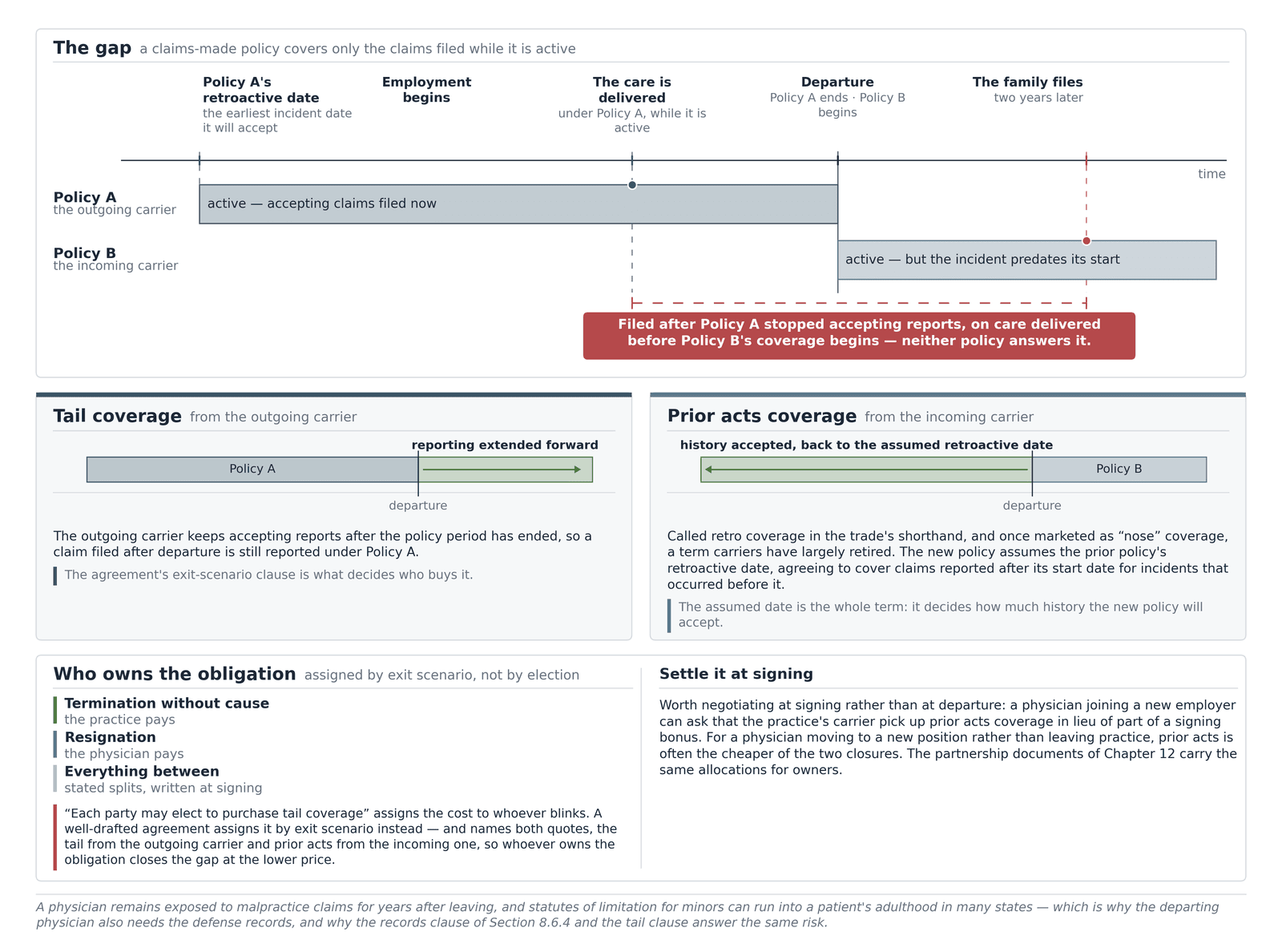
Pediatrics has reason to care about the reporting gap more than most specialties. In many states the limitations period for a claim brought on behalf of a minor is tolled, meaning the clock does not run in the ordinary way until the child reaches the age of majority, which stretches the exposure on pediatric care well past the horizon an adult specialty plans around. How far it stretches, and under what exceptions, is a question of state law that the practice’s coverage counsel and broker answer together—before the policy type is chosen, not after a partner has already left.
Now the sentence that causes the fights. “Each party may elect to purchase tail coverage” assigns the cost to whoever blinks first, which is another way of saying it assigns the cost to litigation. Assign it by exit scenario instead. The practice pays on termination without cause and on death, disability, and retirement at or beyond a stated tenure. The departing physician pays on resignation before that tenure and on termination for cause. Graduated splits fill the middle, often by years of service, so that a partner of 15 years and a partner of 15 months are not treated as the same event. The same allocations belong in both documents—the employment agreement for the physician’s employment relationship, the partnership agreement for the equity relationship—because a partner exits both on the same day and the two papers fire at different moments off that single shared date.
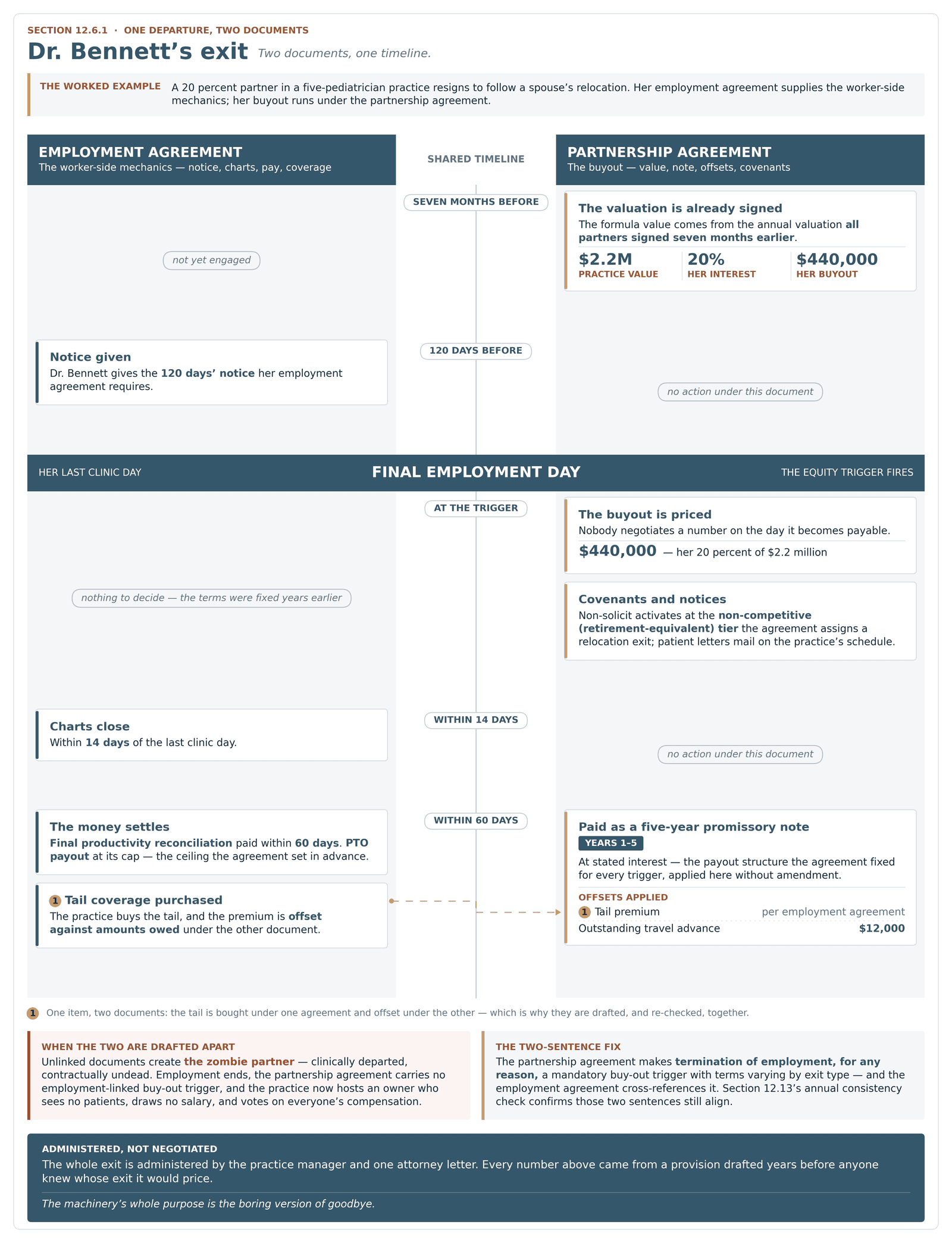
The worked mechanics matter as much as the allocation. Decide when the premium is due relative to the final payout, and whether it is offset against amounts the practice owes. One well-drafted exit shows the pattern. Dr. Bennett, a 20 percent partner in a five-pediatrician practice, resigns to follow a spouse’s relocation, and her tail is purchased by the practice with the premium offset against the amounts owed to her, alongside an offset for a $12,000 outstanding travel advance, with the balance paid on a five-year promissory note. No meeting was required to reach any of it. Every number came from a provision drafted years before anyone knew whose exit it would price.
Coverage standards deserve their own sentences. State the minimum per-claim and aggregate limits every partner must carry. State whether defense costs erode those limits or sit outside them, because an eroding-limits policy at $1 million is not the same product as a policy at $1 million with defense outside. State the carrier standard—a minimum financial-strength rating, or an approved-carrier list—and require partner approval before the practice changes carriers, because a carrier change on a claims-made program can reset a retroactive date and silently manufacture the exact gap the agreement was written to prevent. Address the consent-to-settle clause: whether the physician may refuse a settlement the carrier wants, and what happens economically when she does. And decide who owns the relationship with the broker, so the annual renewal is reviewed by someone whose job it is to read it.
Ongoing premiums need an allocation rule too. Where the practice pays malpractice premiums as an operating expense, the cost is socialized, and a partner whose claims history raises the group’s rate is subsidized by colleagues who will never say so out loud until the renewal arrives. Where premiums are individually allocated, the arithmetic is cleaner and the part-time partner stops paying for coverage she does not use at full scale. Neither answer is wrong. The unwritten answer is.
Red flags. Policy type never discussed, with partners holding different assumptions about the same document. Tail cost unaddressed, so the departing partner assumes the practice pays and the practice assumes the opposite. No stated minimum limits, or limits that have not been revisited since the practice had half its current volume. A mid-year departure that turns a tail obligation into a negotiation over the final payout. A carrier changed without partner approval, and nobody checked what happened to the retroactive date.
Tail disputes do not arrive while the physicians are getting along. They arrive precisely when they are not—which is exactly why the allocation belongs in writing while everyone still likes each other.
Red Flags in a Malpractice Coverage Provision
- Policy type never discussed, with partners holding different assumptions about the same document.
- Tail cost unaddressed, so the departing partner assumes the practice pays and the practice assumes the opposite.
- No stated minimum limits, or limits not revisited since the practice had half its current volume.
- A mid-year departure that turns a tail obligation into a negotiation over the final payout.
- A carrier changed without partner approval, with nobody checking what happened to the retroactive date.
| Exit scenario | Who pays the tail premium |
|---|---|
| Termination without cause | The practice |
| Death, disability, or retirement at or beyond a stated tenure | The practice |
| Resignation before that stated tenure | The departing physician |
| Termination for cause | The departing physician |
| Exits between those poles | Graduated split, often by years of service |
Frequently asked questions
Who pays for tail coverage when a physician leaves a practice?
Well-drafted agreements assign the cost by exit scenario rather than leaving either side to elect. A common construction has the practice pay on termination without cause and on death, disability, and retirement at or beyond a stated tenure, and the departing physician pay on resignation before that tenure and on termination for cause, with graduated splits by years of service in between.
What is the difference between tail coverage and prior acts coverage?
Tail coverage, an extended reporting endorsement, comes from the departing carrier and extends the window during which claims may be reported, at a premium commonly one and a half to two times the annual policy cost. Prior acts coverage comes from the incoming carrier instead, whose new policy assumes the old retroactive date. An agreement should name both quotes.
Why does the malpractice reporting gap matter more in pediatrics?
In many states the limitations period for a claim brought on behalf of a minor is tolled, so the clock does not run in the ordinary way until the child reaches the age of majority. That stretches exposure on pediatric care well past the horizon an adult specialty plans around. How far it stretches is a question of state law for coverage counsel and the broker.
Put the agreement to the test
The Partnership Agreement Analyzer scores an existing agreement against the framework this series is built on — or schedule a discovery call to work through it with PMI. The full framework, with the arithmetic, lives in the textbook Pediatric Practice Management: The Fundamentals.