A buyer who conducts thorough due diligence is exactly the kind of partner you want—someone who is serious, methodical, and committed to making an informed decision rather than an impulsive one.
Buying into a pediatric practice is one of the most significant financial and professional decisions a physician will ever make. It is not simply a career move—it is an investment of capital, reputation, and future earning potential. Yet too many pediatricians approach this decision with less scrutiny than they would give to purchasing a home. Due diligence is the process that protects you from costly surprises and ensures the opportunity is everything it appears to be.
What Is Due Diligence and Why Does It Matter?
Due diligence is a comprehensive investigation of a business before entering into a transaction. In the context of buying a practice interest, it means systematically reviewing the financial health, legal structure, operational performance, and risk profile of the practice before you commit your money and your career.
Think of it this way: you would never prescribe a treatment without first taking a thorough history and running appropriate diagnostics. The same principle applies here. The practice may look healthy on the surface—a busy waiting room, a good reputation in the community, a friendly group of partners—but beneath those appearances, there could be declining collections, unfavorable payer contracts, unresolved legal exposure, or governance structures that leave you with no meaningful voice in how the practice is run.
Without due diligence, you are essentially writing a large check based on trust alone. Trust is important in any partnership, but it is not a substitute for verified facts.
What Should a Prospective Buyer Be Looking For?
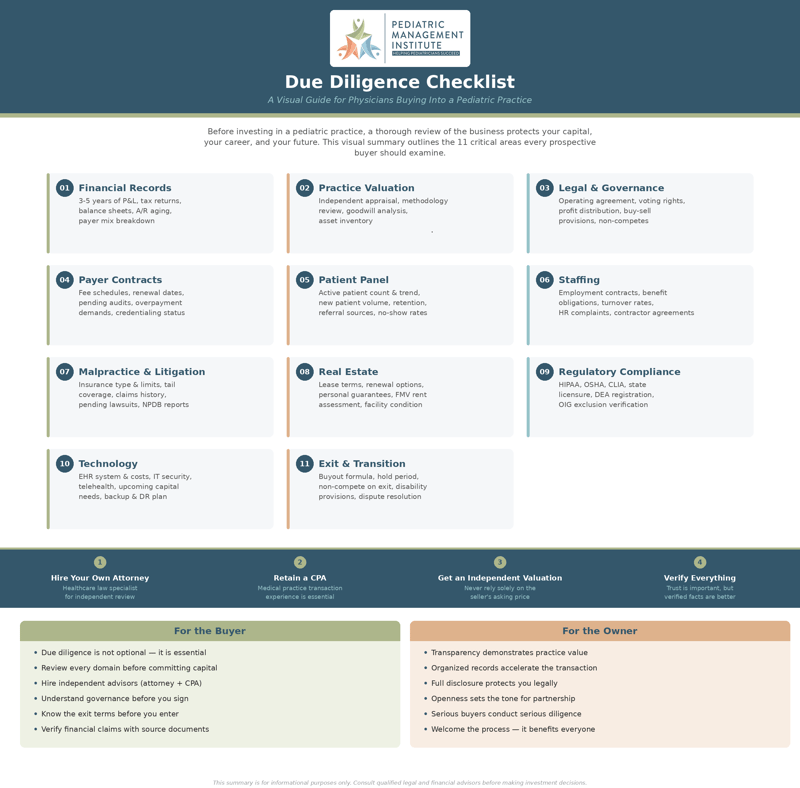
A reasonable due diligence process for an "internal buyer" covers several critical domains:
Financial Performance
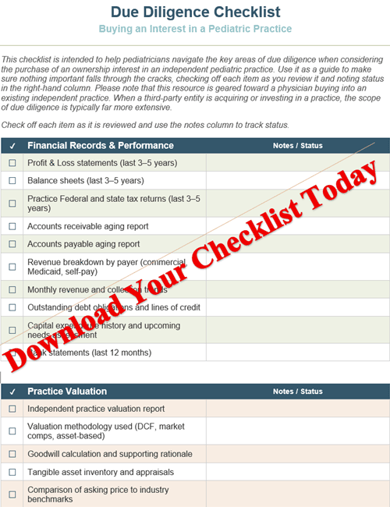
Request at least three to five years of tax returns, profit and loss statements, balance sheets, and accounts receivable aging reports. You need to understand not just current revenue, but the trend. Is the practice growing? Are collections keeping pace with charges? What is the payer mix, and how heavily does the practice depend on lower-reimbursement sources like Medicaid? A practice that looks profitable on paper may have serious cash flow issues lurking in its aging receivables.
Practice Valuation
How was the buy-in price determined? If the answer is “we just picked a number,” that is a red flag. A legitimate valuation should be performed by a qualified, independent firm using recognized methodologies. You should understand exactly what you are paying for—tangible assets, goodwill, or some combination—and whether the price is reasonable relative to the practice’s actual earnings.
Legal and Governance Structure
The operating or partnership agreement is the rulebook for your investment. It dictates how profits are divided, how decisions are made, what happens when a partner wants to leave or becomes disabled, and whether you will have any real authority or simply be a junior partner with no vote. Read every word of this document, and have your attorney review it as well.
Payer Contracts and Compliance
Review the practice’s contracts with commercial insurers and government programs. Are rates competitive? Are there upcoming renegotiations that could affect revenue? Has the practice been audited? Are there any pending overpayment demands or compliance investigations? These issues can represent substantial financial liability that transfers to you as an owner.
Malpractice, Litigation, and Risk
A full disclosure of malpractice history, pending lawsuits, and regulatory actions is essential. Understand the type of malpractice insurance the practice carries and whether you will be responsible for tail coverage costs. Undisclosed litigation risk can be financially devastating.
Operations, Staffing, and Technology
Evaluate the patient panel size and growth trajectory, staffing stability, key employee contracts, the EHR system, and any capital expenditures on the horizon. Operational weaknesses that seem manageable today can become expensive problems once you are an owner responsible for your share of the costs.
A Message to Practice Owners: Why You Should Embrace Transparency
If you are a practice owner preparing to bring in a new partner, you may feel that a prospective buyer’s request for extensive financial and operational records is intrusive or signals a lack of trust. In reality, the opposite is true. A buyer who conducts thorough due diligence is exactly the kind of partner you want—someone who is serious, methodical, and committed to making an informed decision rather than an impulsive one.
Here is why being prepared to share this information benefits you as the seller:
It Demonstrates the Value of Your Practice
If your practice is well-run and financially healthy, the numbers will speak for themselves. Transparency builds confidence and often justifies your asking price more effectively than any sales pitch. Conversely, if you are reluctant to share financials, a sophisticated buyer will wonder what you are hiding—even if there is nothing to hide.
It Accelerates the Transaction
Buyers who cannot get the information they need will either walk away or drag the process out with repeated follow-up requests. Having a well-organized data room with key documents ready to share streamlines the entire timeline and reduces legal costs on both sides.
It Protects You Legally
Full disclosure during due diligence is your best protection against post-closing disputes. If a buyer later claims they were not informed about a material issue, your documented disclosure process is your defense. Incomplete or reluctant disclosure, on the other hand, can expose you to claims of misrepresentation.
It Sets the Tone for a Healthy Partnership
The due diligence process is a preview of how you and your future partner will work together. If the relationship begins with openness and mutual respect, it establishes a foundation of trust that will serve the practice well for years to come. If it begins with suspicion and withheld information, you are already on shaky ground.
The Bottom Line
For the buyer, due diligence is not optional—it is essential. It is the process that transforms a hopeful opportunity into a well-understood investment. For the seller, willingness to support that process signals integrity and confidence in the value of what you have built.
Both parties benefit when the transaction is grounded in facts, transparency, and professional guidance. Retain a healthcare attorney and a CPA experienced in medical practice transactions, and approach the process as partners working toward a shared goal: a successful, thriving pediatric practice.