
Borrowing is the fastest way for one partner to bind everyone else, so debt authority is drafted to the same standard as capital calls. Thresholds tie authority to the size and reversibility of the obligation, personal guarantees are allocated pro rata with release mechanics for a departing guarantor, and ownership interests cannot be pledged as collateral.
The renewal notice from the bank is addressed to the practice, and it is how three of the four partners learn that the practice has a $1 million line of credit. It was opened 14 months ago. It carries covenants nobody has read, a personal guarantee whose signature block lists one name, and an interest rate that made sense at the time. Nothing improper has necessarily occurred. Something structural has: the practice took on an obligation that every owner shares, through a decision only one owner made.
Borrowing is the fastest way for a single partner to bind everyone else, which is why debt authority is drafted to the same standard as capital calls. The two provisions are halves of one question—where the practice’s money comes from when operations do not supply it—and an agreement that governs one while ignoring the other has left the cheaper door open.
Set the thresholds first, and set them as a scale rather than a rule. A workable tier framework gives the managing partner or administrator unilateral authority up to a stated dollar figure, a notice-and-objection band above it where spending proceeds after several business days unless a partner objects, a simple-majority vote above that, and a supermajority for the decisions that are hardest to undo. Borrowing above a major threshold sits in the last tier, alongside issuing personal guarantees, opening or closing locations, and amending the agreement. The principle underneath is reversibility: the harder a decision is to reverse, the more consensus it should cost. A vendor contract can be canceled. A seven-year term loan with a prepayment penalty cannot.
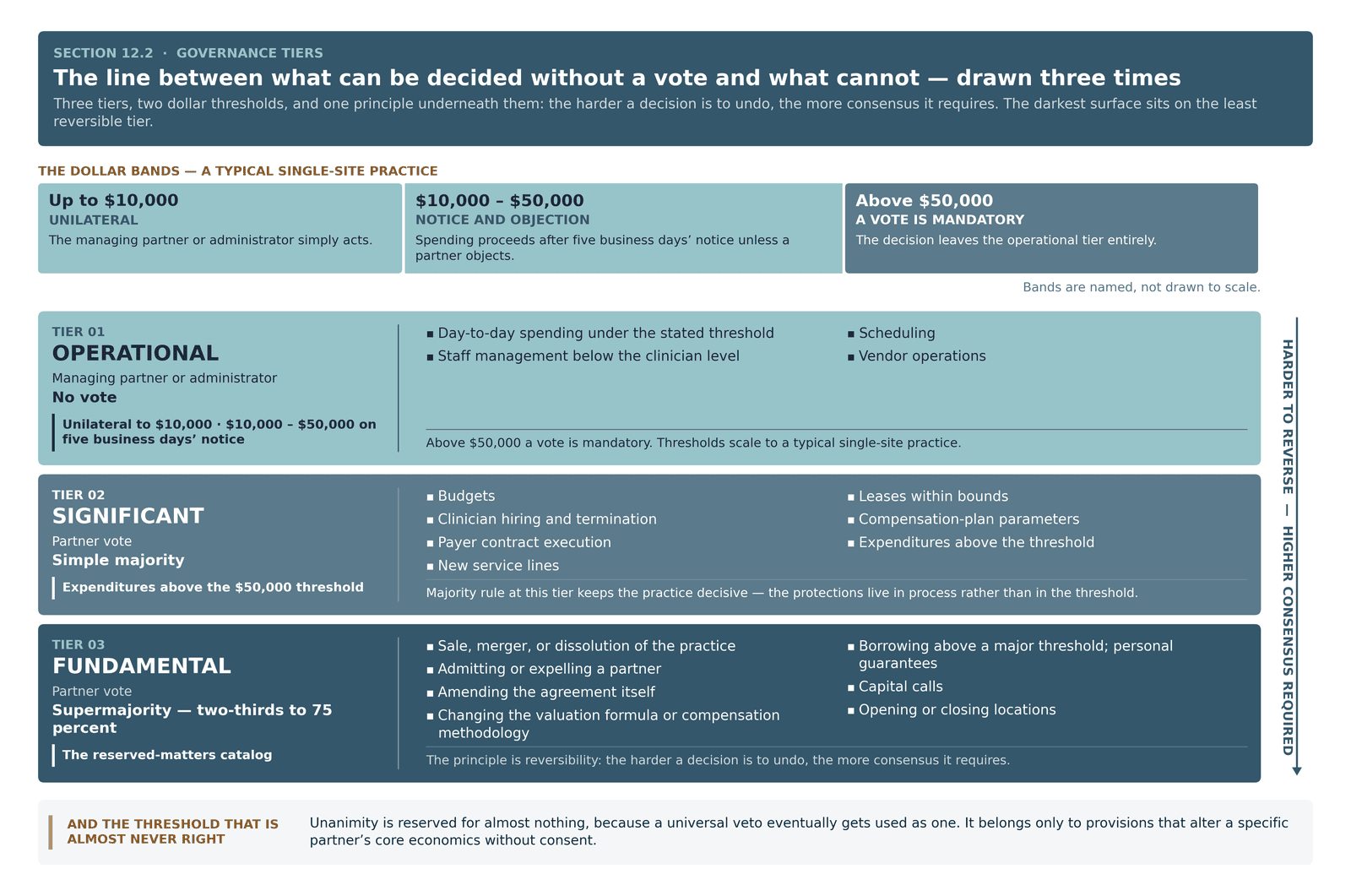
Two habits keep the thresholds honest. Index them, or revisit them annually, so numbers set when the practice had half its current volume do not govern a decade later. And name signature authority explicitly—who may bind the practice contractually, and in what amounts. The internal limit governs the partners; whether it binds an outside lender who dealt in good faith with an apparently authorized officer is a question of agency law and of the lender’s own documents, and it belongs to counsel rather than to a partner meeting. The agreement’s contribution is to make an unauthorized signature the signer’s problem: internally recoverable, and a stated cause for removal from the managing role.
Personal guarantees are where the exposure turns personal, and they are drafted badly more often than any other financing provision. Most lenders to a physician practice will require them, so the agreement’s job is allocation rather than avoidance. State the formula—pro rata by ownership is the standard—and state that any partner asked to guarantee beyond her share is entitled to indemnity from the others. Then write the release mechanics, which is the provision guarantors forget until the bank reminds them. A departing partner does not stop being a guarantor because she stopped being a partner; lenders release guarantors when they choose to, and rarely for free. Decide in advance whether the practice must use reasonable efforts to obtain a release, whether it indemnifies the departed partner meanwhile, and whether refinancing to accomplish the release is an obligation or an option. The same logic governs the building lease, which functions as a guarantee whether or not anyone calls it one.
Prohibit pledging ownership shares as loan collateral, without exception. A partner who pledges her equity to secure a personal debt has handed a lender a contingent claim on the practice’s cap table, and the day that lender forecloses is the day the transfer restrictions everyone drafted so carefully meet a creditor who never agreed to them. The prohibition costs nothing to include and closes a door that cannot be closed later.
Covenants need their own governance, because covenant breaches are discovered by lenders more often than by partners. Require the practice to monitor compliance against every facility, report the covenant position in the quarterly financial review, and follow a defined remediation sequence when a test is missed or is about to be:
- Notify all partners in writing within a stated number of days of the breach or the projection of one.
- Suspend distributions until the position is cured, since most facilities restrict them anyway and voluntary restraint reads better than a lender’s demand.
- Fund the cure from reserves, then by capital call at the authorized tier, then by refinancing.
- Approach the lender for a waiver or forbearance only with named authority, so one partner does not negotiate the practice’s balance sheet alone.
Two disclosure duties finish the structure. Every credit facility, guarantee, lease guarantee, and equipment financing gets listed annually for the partners, with balances, maturities, covenants, and the guarantors named—a single schedule, refreshed at the annual agreement audit. And related-party borrowing runs through the conflict machinery: a partner lending money to the practice discloses the terms in writing before the decision, recuses herself from the vote, and the recusal does not count toward the threshold. Arm’s-length pricing gets documented against outside comparables. A partner loan at a fair rate is a useful instrument. A partner loan at a rate nobody benchmarked is a distribution wearing a disguise.
Coordinate all of it with the capital call provisions of article 11. Lenders care intensely about where the partners’ internal promises sit relative to the bank’s repayment rights, and reconciling capital call priority and subordination in the loan documents in advance saves a negotiation later. Acme Pediatrics financed its second location with $700,000 of term debt beside a $1.2 million capital call, voted at the supermajority the agreement required. The bank’s counsel found the priority language already drafted and moved on.
Red flags. A managing partner who can borrow without a ceiling or a vote. Personal guarantees allocated by who happened to be available to sign. Ownership interests pledged as collateral. Covenant violations that reach the partners through the lender. No annual disclosure of existing facilities, so the practice’s true leverage is assembled from memory. And borrowing from a related party on terms nobody documented or benchmarked.
Every dollar the practice borrows is a liability shared by every partner, including the ones who never saw the paperwork. The provision that decides who may create that liability is worth more than the rate.
Covenant breach remediation sequence
- Notify all partners in writing within a stated number of days of the breach or the projection of one.
- Suspend distributions until the position is cured, since most facilities restrict them anyway and voluntary restraint reads better.
- Fund the cure from reserves, then by capital call at the authorized tier, then by refinancing.
- Approach the lender for a waiver or forbearance only with named authority, so no partner negotiates the balance sheet alone.
Frequently asked questions
Should a managing partner be able to borrow money without a vote?
Not above a stated ceiling. A workable tier framework grants unilateral authority up to a dollar figure, a notice-and-objection band above it, a simple-majority vote above that, and a supermajority for borrowing at a major threshold, alongside personal guarantees and amendments to the agreement. The principle underneath is reversibility: the harder a decision is to undo, the more consensus it should cost.
How should personal guarantees be allocated among partners?
Most lenders to a physician practice require them, so the agreement allocates rather than avoids. Pro rata by ownership is the standard, and any partner asked to guarantee beyond her share is entitled to indemnity from the others. Release mechanics matter as much: a departing partner does not stop being a guarantor because she stopped being a partner.
Can a partner pledge her ownership interest as loan collateral?
The agreement should prohibit it without exception. A partner who pledges her equity to secure a personal debt hands a lender a contingent claim on the practice’s cap table, and the day that lender forecloses is the day carefully drafted transfer restrictions meet a creditor who never agreed to them. The prohibition costs nothing and closes a door that cannot be closed later.
Put the agreement to the test
The Partnership Agreement Analyzer scores an existing agreement against the framework this series is built on — or schedule a discovery call to work through it with PMI. The full framework, with the arithmetic, lives in the textbook Pediatric Practice Management: The Fundamentals.