
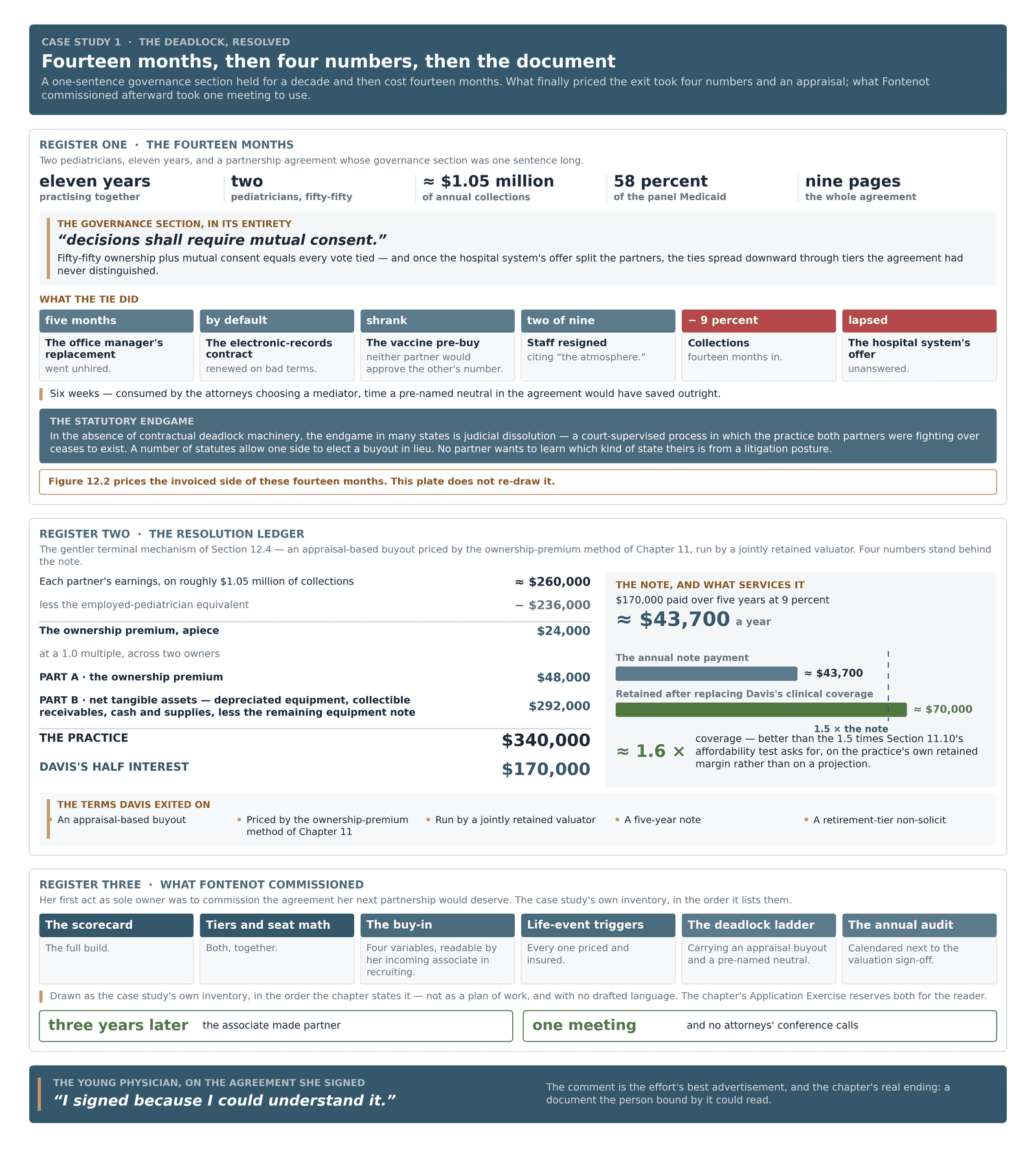
Two pediatricians had worked together for 11 years in a rural county, where their two-physician office was, functionally, the county’s pediatric infrastructure: about $1.05 million in annual collections, a panel 58 percent Medicaid, and a partnership agreement nine pages long. Its governance section, start to finish, read: “decisions shall require mutual consent.” The sentence worked for a decade, because the partners agreed on everything that mattered. Then a regional hospital system offered to acquire the practice, and they stopped agreeing. Davis, 61, with a spouse ready to travel, wanted to sell. Fontenot, 48, refused. Equal ownership plus mutual consent produces the same arithmetic every time. The vote ties, and nothing in the document says what happens next.
The part practices underestimate is what came after. Deadlock does not stay on the question that caused it. Because the disagreement poisoned the well, the ties spread downward through every decision the agreement had never bothered to distinguish from the sale. The office manager’s replacement went unhired for five months. The electronic-records contract renewed by default on bad terms. The vaccine pre-buy shrank, because neither partner would approve the other’s number. Two of the practice’s nine staff resigned, citing the atmosphere. Nobody decided any of it. Default decided all of it. Fourteen months in, collections had fallen 9 percent and the hospital’s offer had lapsed unanswered.
Then Fontenot’s attorney delivered the sentence that reorganizes every 50/50 partner’s understanding of the situation. Where an agreement carries no deadlock machinery, the statutory endgame in many states is judicial dissolution—a court-supervised process in which the practice both partners were fighting over ceases to exist. A number of statutes allow one side to elect a buyout in lieu of dissolution instead. Which kind of state a practice sits in is a question for counsel, answered in advance. No partner should be learning it from a litigation posture.
So the drafting starts with a definition rather than a remedy, because deadlock is not every disagreement. A workable clause defines it narrowly: a fundamental-tier matter that fails to achieve its required vote at two consecutive noticed meetings held at least 30 days apart. That definition does one job, and it is the job that keeps the machinery from firing at the wrong moment. It filters the transient from the terminal. A partner who sleeps on a decision and changes her mind at the second meeting was never in deadlock. A partner who votes the same way twice, 30 days apart, is.
What follows the definition is a ladder, and each rung costs roughly an order of magnitude less than the one above it:
- Structured discussion and a noticed re-vote. The dispute goes in writing, a partners’ meeting is called with minutes taken, and a defined cooling period runs before the second vote. A surprising share of deadlocks are information failures, and they dissolve once both partners are looking at the same monthly financial package.
- Mandatory non-binding mediation. A neutral sits with the partners before any binding process may begin, costs split, settlement discussions privileged.
- The standing tie-breaker. Either a rotating deciding vote or a named neutral—a trusted colleague or advisor empowered in advance to break specified ties.
- The terminal mechanism, for the deadlock that survives everything above it.
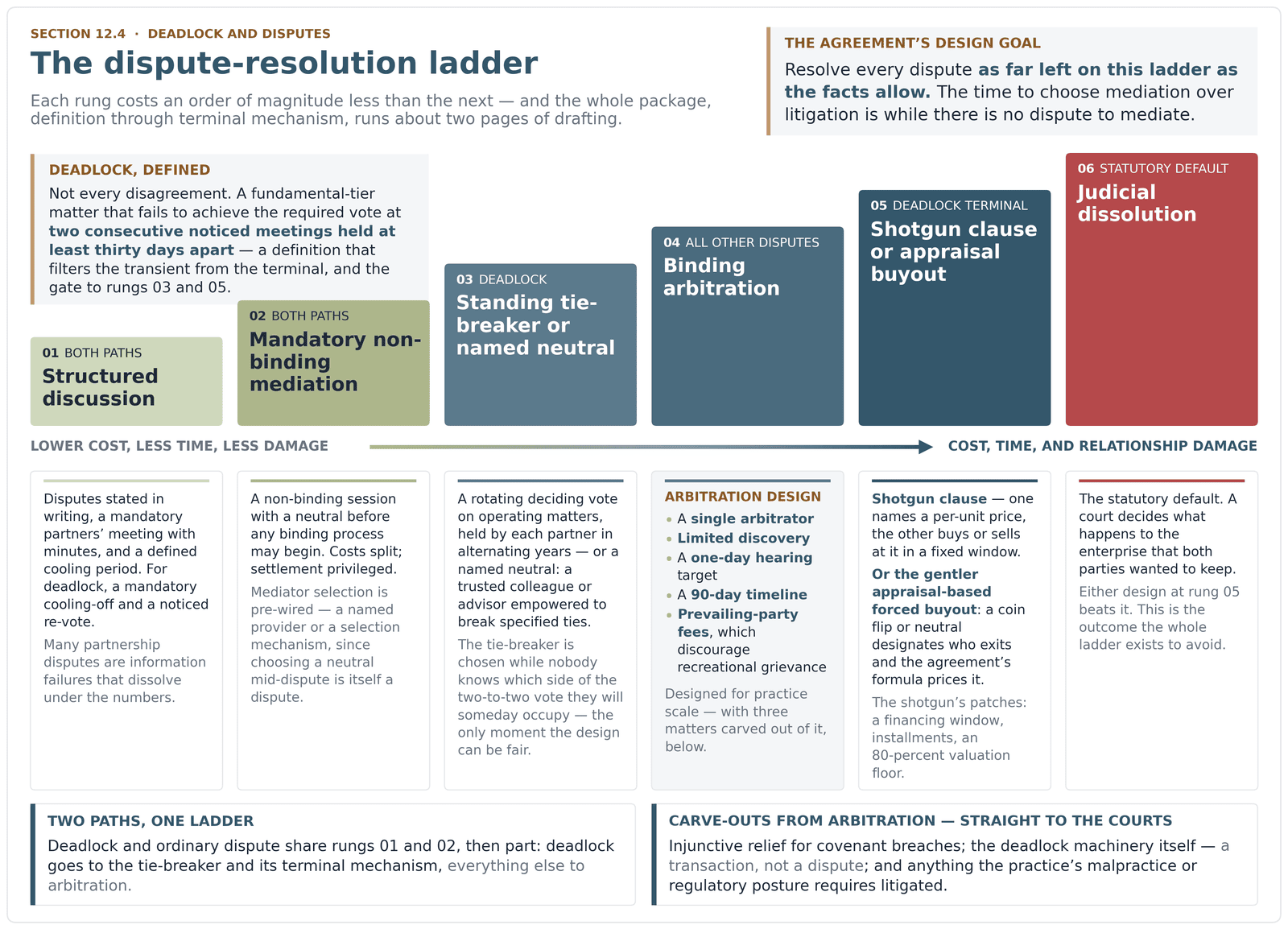
The classic terminal instrument is the shotgun clause, also called the forced buy-sell. Either partner names a single per-unit price, and the other must, within a fixed window, either buy at that price or sell at it. The elegance is self-enforcing honesty. Name low and be bought out cheap; name high and write the check. No appraisers, no experts, no litigation.
The known flaw is capital asymmetry, and it is severe enough that the clause should never be drafted bare. The partner with family money can name a perfectly fair price knowing the partner still carrying medical school debt cannot finance the buy side, which converts an even-handed mechanism into a one-way eviction. Three patches correct it, and all three belong in the draft: a financing window of six to nine months, an installment-payment option, and a price floor at a stated percentage of the last signed annual valuation, where 80 percent is workable. That floor is one more reason to re-sign a valuation every year, whether or not anyone plans to leave.
The gentler alternative many groups now prefer is the appraisal-based forced buyout. A coin flip or a neutral designates who exits, and the agreement’s own valuation formula prices the exit. The price is not a move in the negotiation, because it comes from a formula the partners signed before anyone knew whose exit it would price. That design is steadier than the shotgun and kinder to the partner with less capital, and it is the reason a practice choosing it still needs a current valuation on file.
Match the mechanism to the decision type rather than installing one instrument for everything. Operational ties—the vendor, the schedule change, the equipment purchase—deserve a rotating casting vote held by each partner in alternating years, a design that disciplines both. Reserved matters deserve the full ladder and a terminal mechanism. Nothing deserves a rule that resolution requires unanimous agreement, which is simply the deadlock restated as its own cure. And every rung carries a clock. A deadlock provision with no time limit lets one partner win by waiting, which is what the 14 months above actually were.
Two-partner practices need this more than anyone, and they draft it least. But the exposure is not limited to them. Run the seat math against the actual roster and the surprises appear fast: in a three-partner practice, two-thirds and simple majority are the same two people, so a supermajority there is unanimity whether anyone intended it or not. Any threshold that can produce a tie can produce a deadlock. Translate every threshold in the agreement into names before adoption, and retranslate at every admission.
The two rural pediatricians did reach an agreement, the expensive way. A mediator their attorneys spent six weeks selecting separated the real dispute—sell now, or build toward an internal succession—from 14 months of grievance piled on top of it. What ended it was the gentler terminal mechanism: an appraisal-based buyout run by a jointly retained valuator. On roughly $1.05 million of collections, each partner’s earnings ran about $260,000 against a $236,000 employed equivalent, so the ownership premium came to $24,000 apiece, priced at a 1.0 multiple across two owners for $48,000. Net tangible assets added $292,000. That put the practice at $340,000 and Davis’s half interest at $170,000, paid over five years at 9 percent—a note near $43,700 a year, serviced comfortably by the roughly $70,000 the practice retained after replacing the departing partner’s clinical coverage. Then the other column. Professional fees across the 14 months came to a little over $140,000, and the 9 percent of collections that walked out during the freeze cost roughly $95,000 more. Call it $235,000, against the two pages of drafting that would have prevented most of it.
Red flags. A 50/50 practice with no deadlock provision, where one veto blocks everything. No escalation path, so the first serious disagreement arrives in a courtroom. A forced buy-sell provision with no valuation methodology standing behind it, or no financing window for the partner who cannot write a check on 30 days’ notice. No time limit on how long a deadlock may persist. And a deadlock-resolution clause that requires unanimous agreement to operate.
Deadlock machinery is designed best while nobody knows which side of the tie they will someday occupy. That is the only moment the design can be fair, and it is the only moment it is cheap. A 50/50 partnership without a deadlock provision is one disagreement away from dissolution.
The deadlock escalation ladder
- Structured discussion and a noticed re-vote, with the dispute in writing, minutes taken, and a defined cooling period.
- Mandatory non-binding mediation before any binding process may begin, costs split and settlement discussions privileged.
- A standing tie-breaker: a rotating deciding vote, or a named neutral empowered in advance to break specified ties.
- A terminal mechanism, the shotgun clause or appraisal-based forced buyout, for the deadlock that survives every rung above.
- A clock on every rung, because a deadlock provision with no time limit lets one partner win by waiting.
Frequently asked questions
What happens if 50/50 partners cannot agree?
Where an agreement carries no deadlock machinery, the statutory endgame in many states is judicial dissolution, a court-supervised process in which the practice both partners were fighting over ceases to exist. A number of statutes allow one side to elect a buyout instead. Which rule applies is a question for counsel, answered in advance rather than from a litigation posture.
What is a shotgun clause in a partnership agreement?
The shotgun clause, also called the forced buy-sell, lets either partner name a single per-unit price; the other must then buy at that price or sell at it within a fixed window. Its known flaw is capital asymmetry, so three patches belong in the draft: a financing window of six to nine months, an installment-payment option, and a price floor at a stated percentage of the last signed annual valuation.
Can a three-partner practice deadlock?
Any threshold that can produce a tie can produce a deadlock. In a three-partner practice, two-thirds and simple majority are the same two people, so a supermajority there is unanimity whether anyone intended it or not. Translating every threshold in the agreement into names before adoption, and retranslating at every admission, surfaces that arithmetic early.
Put the agreement to the test
The Partnership Agreement Analyzer scores an existing agreement against the framework this series is built on — or schedule a discovery call to work through it with PMI. The full framework, with the arithmetic, lives in the textbook Pediatric Practice Management: The Fundamentals.